| To Intergenerational Connection
| Mark Swartz
| When Isabel Postelnek took a part-time job at an assisted living facility the summer before her freshman year of college, she was planning to become a child psychologist. Within a week, she had changed her mind. “I realized I had found my passion,” she says. “I love working with kids, but not as much as I love working with older adults.”
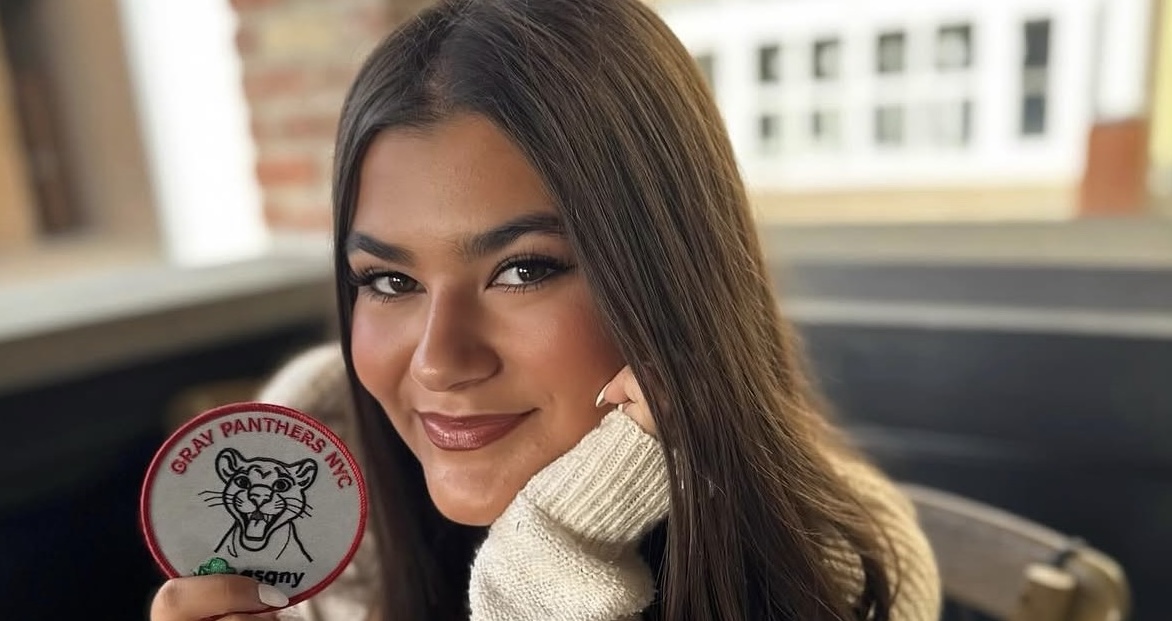
That pivot eventually led Postelnek, now a Ph.D. student in gerontology, to an internship with Gray Panthers NYC in the summer of 2024 — and to designing an inventive initiative that’s starting to spread: a Girl Scout patch focused on ageism, intergenerational connection, and the legacy of the Gray Panthers’ founder, Maggie Kuhn.
Kuhn founded the organization in 1970 after she was forced to retire from her job on her 65th birthday. Rather than accept the verdict quietly, she gathered a group of friends and colleagues and built a movement. The Gray Panthers became known for framing aging as a social justice issue, not merely a personal one, and for its belief that old and young were natural allies rather than rivals. Kuhn’s New York Times obituary quotes her as saying: “Our society has categorized people by age and put them in boxes. We are trying to take people out of boxes and get them together.”
Support independent journalism on aging
Today, Michelle Arnot and Carrie Leljedal co-lead Gray Panthers NYC, bringing complementary skills and experiences. Arnot came through professional channels. She had been working with Presbyterian Senior Services when she met Jack Kupferman, then president of Gray Panthers NYC. For Arnot, “That intergenerational relationship was the key to all of it. Whether it was Maggie’s personal relationships, her co-housing when she moved to Philadelphia — there was always that intergenerational component somewhere, because that’s also part of natural aging.”
Leljedal’s path was less direct. She has an adult son who lives in a care facility, and when the pandemic cut off her access to him, she channeled her anger into activism. “The madder I got, the more I reached out, the more I met people,” she says. She began working with advocates around the country, including Caregivers for Compromise, a coalition focused on passing essential caregiver legislation. Through that network she found her way to Gray Panthers NYC. Her involvement put a sharp edge on a point Kuhn had always made: “Maggie made it very clear — this wasn’t just about old people,” Leljedal says. “People did not realize that people like my son received care every day, whether they’re at home, in a care facility, in a small community house.”

It was into this environment that Postelnek arrived as an intern. A lifelong Girl Scout, she saw an opportunity when the organization expressed interest in connecting with local troops. She proposed the patch, a community-based award less rigorous than an official badge but grounded in real engagement with the world outside the troop meeting.
The patch she designed is carefully calibrated by age. The youngest Daisies begin with a read-aloud — written by Postelnek — that introduces them to the Gray Panthers, to Maggie Kuhn’s story, and to the concept of ageism in plain language. They complete a coloring page. As girls move through the program’s levels, the activities deepen: worksheets for Brownies, goodie bags and cards to bring to nursing homes and assisted living facilities, and for high schoolers, the option to do direct one-on-one work with Gray Panthers members. The patch is available to every level of Girl Scout, from the youngest Daisies through Ambassadors. “I really wanted to make sure that all Girl Scouts could have this opportunity,” Postelnek says, “because the Gray Panthers message was all about intergenerational connections.”
The program launched in New York and has since spread to Texas, with conversations underway with Girl Scouts of New Jersey. Postelnek describes the moment she received photographs of girls completing the activities as unexpectedly moving. “I’m watching these little girls learn about something that means so much to me, and hopefully it’s sticking with them,” she says. “And even if it’s not, they took the time to learn about it, and later on down the road they might be able to look back on it.”
Arnot sees the patch as an expression of something central to the Gray Panthers’ identity. “No matter which way you looked at it,” she says of Kuhn’s worldview, “there was always that intergenerational component.” For Postelnek, who changed her entire career trajectory after a week with older adults, and for the girls earning their patches in living rooms and troop halls across three states, that component appears to be taking root.
Mark Swartz is founder and publisher of Aging in America News.
Leave a Reply