
| One Journalist’s Half-Century Perspective on Author’s Peculiar Thesis
| Paul Kleyman
| This is an excerpt from Kleyman’s response to “Gerontocracy in America.”
You can read the full piece here.
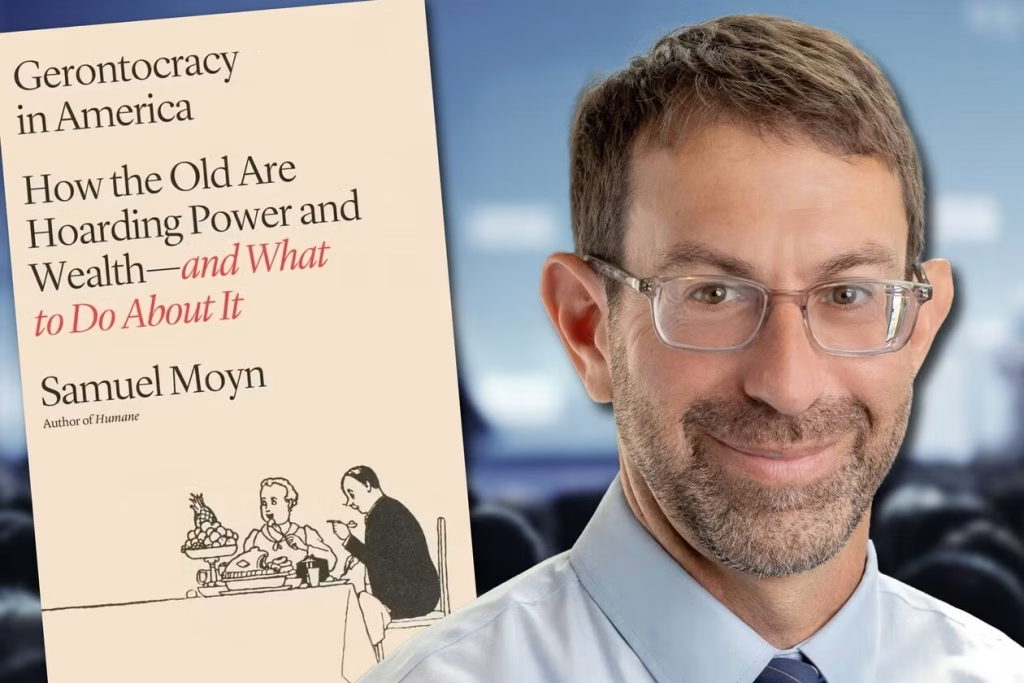
| I read Samuel Moyn’s new book, Gerontocracy in America: How the Old Are Hoarding Power and Wealth—and What to Do About It (Farrar, Straus & Giroux) through my own filter as a journalist who has covered pretty much all of the issues Moyn broaches over the half century since my book, Senior Power: Growing Old Rebelliously (Glide, 1974) came out. It struck me that, more elementally than the author’s rehashing of old right-left debates, Moyn wrestles viscerally with the underlying political philosophy between the presumption of a limited “pie” of public resources and the more promising vision of expanding resources that may emerge from a more mature and robust aging population.
Support independent journalism on aging
Lost to Moyn, and evidently to major publishing concerns that have given the book national exposure, is that the professor’s scholarship creaks throughout Gerontocracy in America with simplistic explanations, factual gaps, and retreaded political tropes. In each discourse around America’s social and economic infrastructure, he omits key elements that any debater would find essential to acknowledge in countering opposing views. Among numerous examples:
- Moyn berates older people for causing today’s housing shortage by fomenting the “taxpayer’s revolt” that began with California’s Proposition 13. But he neglects to mention that the law’s capping of property taxes applied not only to residential homes, but to commercial properties–to the tune of up to $12 billion annually, estimated by the California’s Legislative Analyst’s Office, in 2019.
- The Yale professor quotes a controversial 2013 Urban Institute report calculating that $7 in federal spending goes to older Americans for every $1 in spending for children’s programs. Absent is that most children’s funding in the United States is in state spending for education and other child and family services. A 2013 analysis by the John A. Hartford Foundation (“Misleading Federal Spending Stats Pit Children vs. Older Adults”) explained that combining state and federal spending “shows that the difference declines to a ratio of about 2 to 1 in favor of older adults, down from the hyperbolic 7 to 1.” What’s more, Hartford’s economists wrote that including “Social Security income as a federal outlay for elders—and not viewing it as a benefit system we all pay into . . . doesn’t make sense.” Also, who’s at fault for exploding Medicare expenditures, as well as Medicaid cuts affecting both ends of the age scale?
- The Ivy League history and law professor advocates for a new wave of mandatory retirements, in a fiscal moment when employers are facing long-predicted labor shortages. Yet he doesn’t at least acknowledge years of international efforts to utilize today’s healthier senior population by developing age-diverse workplaces. Failure to do so and block age-based job discrimination will cost the United States, alone, $113.5 billion by 2040, according to new research by the World Economic Forum (WEF).
- Past expectations have proved wrong that the Boomer generation would hit old age with a tsunami of dementia. Biodemographers at Duke University demonstrated in “Changing Story of the Dementia Epidemic” (JAMA, March 12, 2025) that the incidence of dementia plunged from about 30% to 10% between 1984 and 2024. The prospects of losing one’s “marbles” beyond age 65 are no long inevitable, in Moyn’s mythical depiction, for 90% of us.
Ashton Applewhite and Arielle Galinsky: This Isn’t a Generational War
Margaret Morganroth Gullette: The Old Do Not Eat the Young
Repeatedly, Gerontocracy in America dotes on the generational selfishness of older people and their advocates. In doing so, he overlooked substantial intergenerational initiatives, such as Bill McKibben’s Third Act, for 60-plus activism on climate change; Marc Freedman’s Co-Generate (with younger co-director, Eunice Lin Nichols), which nurtures cross-generational collaborations to address major issues of the day; and Donna M. Butts, whose nonprofit Generations United (GU) has joined with national child welfare organizations for decades to support grandparents raising their grandchildren, help foster kids, and develop forums, such as to educate older voters about the value of supporting school and related issues on local ballots. Butts, who recently retired from heading GU for nearly three decades, has published her new book, Grandfamilies: Stories of Children and the Loving Relatives Who Raise Them.
Particularly inspiring to current generations of advocates for intergenerational justice, who Moyn fails to acknowledge, was Gray Panthers Founder, Maggie Kuhn, who lost her job at 65 to mandatory retirement. She lived long enough, until age 89, to successfully lobby Congress to ban the practice for most areas of employment. In those later years, I’d see her being slowly aided to a stage, where once seated at a table, she would position the microphone with her arthritically crabbed hands, before charging into a galvanizing speech. She’s always concluded by leading the standing-room audience in her Gray Panther Growl. Kuhn’s famous refrain was, “Speak your mind, even if your voice shakes.”
Paul Kleyman is National Coordinator of the Journalists Network on Generations (JNG), which he co-founded in 1993. He edits its e-newsletter, GBONews.org.
Leave a Reply