| At The Met’s latest costume exhibition, aging steps into view
| Bella Bromberg
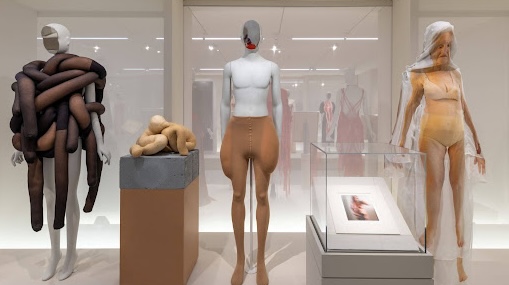
An ivory-haired woman – beige briefs, nude bra, arms outstretched – meets the stranger’s gaze with unmistakable confidence.
Her home is an illuminated case in the Metropolitan Museum of Art; her form is inanimate, her identity unknown.
On a summer Friday, this nameless star drew in two visitors: me and Cyndi Stivers, a former journalist and current TED curator who graduated from Barnard in 1978.
She greeted us in the “Aging Body” section of the museum’s latest costume exhibition, on view through January 2027. Though a look of slight consternation passes over the woman’s face, her posture suggests ease in being observed.

Her outfit, a shroud printed with the visage and body of an older woman, invites befuddlement: she wears this woman like a veil, gauzy skin over plastic.
Support independent journalism on aging
She is a mannequin, in other words: one of nearly 400 objects assembled for Costume Art, curated by Andrew Bolton and installed in the Met’s newly opened Condé M. Nast Galleries, a nearly 12,000-square-foot addition carved from a former exterior courtyard, where the walls deliberately leave scraps of the museum’s 1880s brickwork visible. The show is not organized by era or designer but by body type, including but not limited to: the Naked Body, the Classical Body, the Pregnant Body, the Corpulent Body, the Disabled Body, the Aging Body, and the Mortal Body, each commanding its own distinct section.
Beneath mannequins in bold attire are relics that correspond with each outfit, offering visitors potential reference points. Under a modern black dress with cutouts exposing a mannequin’s bare breasts, for instance, sits a Baroque armored shirt (worn by a rather unlucky female warrior) with matching gaps at the chest.
Every mannequin’s head is a blank, polished steel surface, designed by the artist Samar Hejazi so that visitors can catch their own reflections superimposed on the bodies on display (with the exception of the protagonist initiating the “Aging Body” section; she sports a face of her own).
This particular mannequin—shrouded in the skin of an older woman, with her comfort in confronting the viewer with grace and ease—subverts the accompanying wall text, which argues that the aging process initiates a period of hiding.
The Aging Body is subjected to regimes of surveillance in which morphological changes are often pathologized as moral or personal failures, requiring discipline, correction, or concealment (from “The Aging Body” wall text, Metropolitan Museum of Art).
The shrouded mannequin, an object by Dutch designer Imme van der Haak, upends that notion. She seems to demand attention, and may even enjoy it.
Dress can mediate the course of aging, operating as a bodily practice through which individuals negotiate agency within systems that regulate appearance. (wall text)
Standing before a row of sculptural gowns (one accessorized with a grey sweatshirt playfully proclaiming, “I’m retired. This is as dressed up as I get”), Stivers admitted that she could at times relate to the proclamations on the wall.

“You do become invisible as an older woman,” Stivers said. “Probably around 60, it starts to happen,” she said, smiling.
“You seem quite unbothered by that fact,” I said.
“Yeah, I am!” she said breathlessly.
Nonetheless, Stivers could somewhat understand the piece about concealment. Her upper arms, she said, now hang loose when she straightens them – “not attractive,” she added, “even to me.” Lately, she has taken to long sleeves, a habit she once didn’t understand in older women.
While fashion provides a semiotic toolkit to navigate late-life transitions—offering authority, elegance, or strategic concealment—it also upholds hierarchies that privilege youthfulness. (wall text)

“Now I get it,” she said matter-of-factly, making clear that the choice has caused no psychic wounding. All she wants and asks from her body is that it stay strong and capable of movement.
Aging thus appears simultaneously as physiological transformation and sociocultural negotiation shaped by an increasingly evaluative public gaze. (wall text)
In general, hiding or modifying her body for public gaze was never something that Stivers gave much worry to. She and her friends (many of them friends from Barnard who experienced feminism’s second wave firsthand) have never been squeamish about discussing menopause or hormones with one another, for example. And whatever the wall meant by “sociocultural negotiation,” Stivers seems to have negotiated hers decades ago, alongside a group of women who always valued freedom over conforming to traditional stipulations of female behavior.
Thus, the dressed aging body is caught in a dialectic between aesthetic presence and social erasure. By reframing aging as a mode of sophistication rather than biological decline, the garments and artworks featured here challenge and disrupt fashion’s obsession with juvenescence, recognizing visibility and lived experience as radical aesthetic imperatives. (wall text)

Walking through a room specifically curated to catalog and explain the multifarious burdens that society places on the aging—the surveillance, the concealment, the “evaluative public gaze”—Stivers seemed profoundly, delightfully unperturbed. She simply kept walking, kept looking, kept talking, like someone who has long known the gaze she intended to answer to: her own.
Bella Bromberg is a freelance writer based in New York City. She holds a bachelor’s degree in English from Barnard College, a master’s from Columbia Journalism School, and currently works at TED.
Leave a Reply