| Advocates Call for Reform
| Karen Fischer
| At her core, Yolanda Pope is a nurse, and the entire reason she pursued that career path is her passion for working with older adults. But as the years went by working in the health care system, she saw a stark disconnect for many of her older patients: If they were experiencing homelessness, they couldn’t manage their chronic conditions. Pope recalls working on hospital units where beds were taken up for a month because the patient had nowhere else to go to recover.
When Pope looked into programs to help these patients shift into housing, she was disappointed to find there was no existing model, “so I created one,” she says.

Pope launched DAP Services and Resources in Lansing, Michigan, in October 2021, to provide intensive case management for underserved elderly. In January 2025, she launched the Senior Stability Program, with the goal of sheltering older clients to help them manage their chronic diseases, but she quickly found that the typical framework to do so relies on hotels, which are expensive for a small nonprofit. That led her to launch the Harbor House, a transitional shelter in a home-like setting in November 2025, which provides more support than traditional shelters so that clients with mobility and health issues can walk with plenty of room. Staff also cook and provide one meal per day in a communal kitchen. The second shelter opened in February 2026, and so far, about a dozen people have been served through the model.
But it’s just the start.
“The need is definitely greater than what we can provide,” Pope says. “We’re looking at expanding into a bigger property.”
Support independent journalism on aging
In 2024, over half of Americans saw alcohol, drug use, and mental illness as drivers of homelessness. Visible homelessness is troubling: If one sees someone using intravenous drugs on the street, the subconscious narrative may become that homelessness is a personal choice.
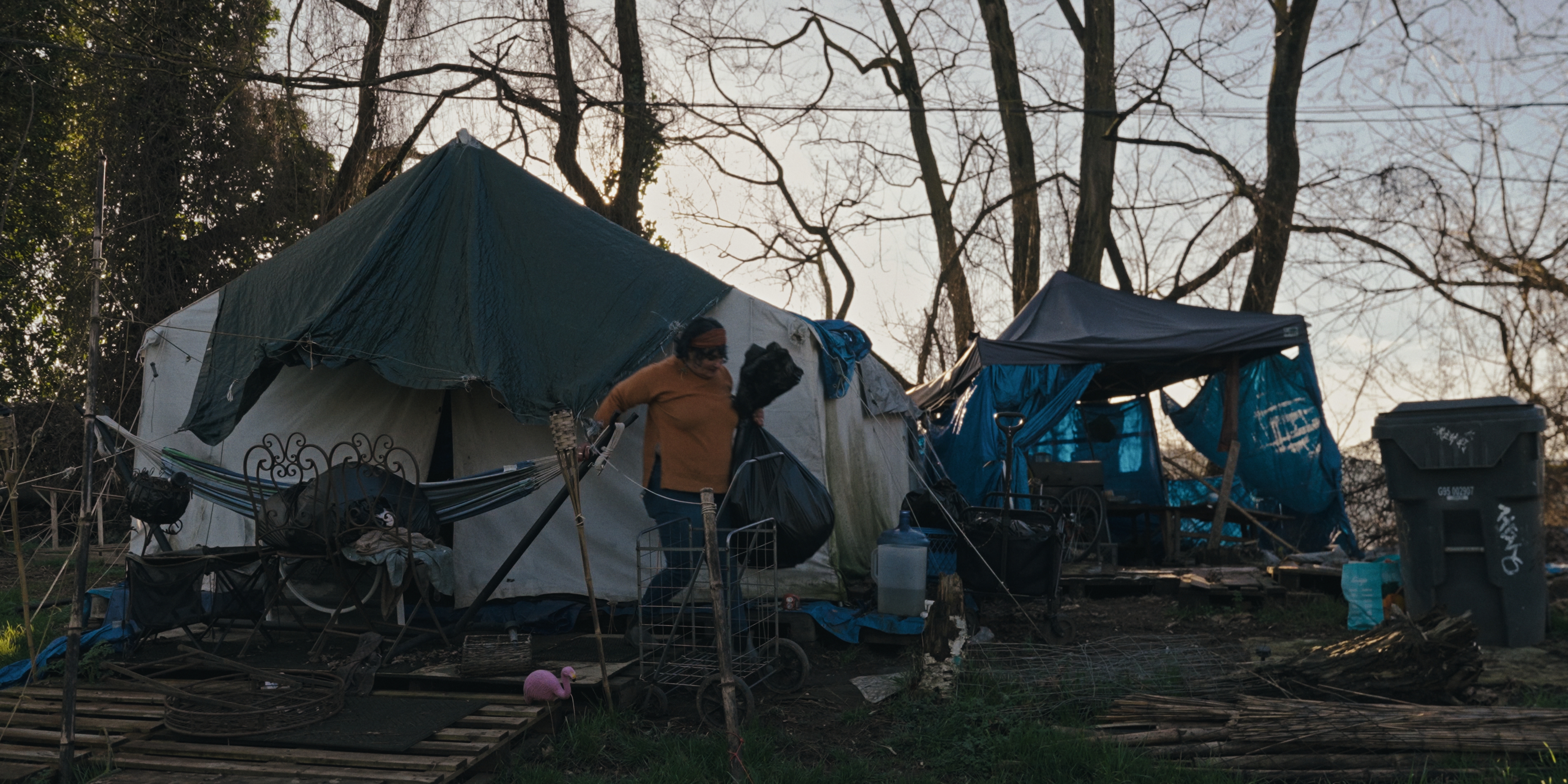
But in reality, a good deal of homelessness is invisible in populations that the average person doesn’t expect. According to the Government Accountability Office, in 2024 one in five people experiencing homelessness was 55 and older. Older people have wheelchairs, walkers, and other mobility limitations that make navigating homeless shelters extremely difficult.
What makes older people more susceptible to homelessness, and what does treating homelessness once it begins and preventing it before it starts look like?
Cause and effect
Pope says that no two of her clients are homeless for the same reason.
“In most cases, this is their first time being homeless,” she says.
One client, for example, was preparing to move into a new apartment, but when they showed up on the first day of their lease, they discovered the apartment didn’t exist. They were scammed out of thousands of dollars between security deposits and rent paid online. As a result, they were unhoused for almost two years.
Other clients are cognitively impaired and can’t manage their bills or navigate the labyrinth of due dates, notices, and terms. Recertification to remain in subsidized housing can also be an immense challenge: A client could forget to sign the bottom of a form or lose paperwork in the mail after moving, and that could result in an eviction notice, Pope says.
When an older adult becomes homeless, so many aspects of chronic condition management become untenable. For example, many have walkers or wheelchairs. They may qualify to enter a homeless shelter, and while shelters are compliant with the Americans with Disabilities Act (ADA), they’re not designed for people with mobility limitations.
A simple example is bunk beds, which are popular in shelters to maximize space. The bottom bunk is usually taken first, Pope says. But not everyone can climb into a top bunk. Older adults may also suffer from incontinence, or have a catheter, or an oxygen tank. All of those medical elements become nearly impossible to manage in a typical shelter environment.
That’s what makes Pope’s transitional housing approach so novel. There are no bunk beds, and the shelter looks and feels just like a normal home, so patients can manage their health needs while collaborating with a caseworker to plan their transition into permanent housing.
Economic risk factors
In 2024 Davey Schaupp, a documentary filmmaker, explored how older Americans are experiencing homelessness in the 50-minute film “No Place to Grow Old.” Schaup profiles three adults over 55 living in Portland; two lost their housing due to predatory home equity loans and rent hikes.

Schaupp felt the need to explore this issue, he says, because locals in Portland have empathy fatigue. In 2025, Portland voters cited homelessness as the number one social concern, but as of April 2026, there are more homeless people within the city than ever before.
“Older adults are the fastest-growing homeless demographic because their incomes are stabilized, and they can’t go back to college and get a degree,” Schaupp says. “By 2030, the number of older adults experiencing homelessness will triple.”
Retired workers are the largest slice of people who receive Social Security today, and the average monthly payment that a retired worker receives is $2,079. Meanwhile, the median rent for a studio apartment throughout the country is $1,393.
Experts cite high costs and limited affordable housing supply as the biggest drivers of homelessness. California, New York, and Massachusetts are the states with the highest percentage of homelessness. These states directly overlap as the locations where the largest share of workers’ income goes towards housing.
Looking ahead
For Pope, a key policy solution to keep older people housed would be capping rent increases for individuals receiving Social Security payments. They already receive a cost of living increase annually, but that’s not keeping up with real-time rent hikes, she says.
In that vein, the margin between being sheltered and not, Schaupp says, is often a question of a few hundred dollars per month, which could be delivered in the form of a rent freeze or housing voucher. That’s a small price to pay when compared to the thousands of dollars spent every year to care for people experiencing homelessness in emergency shelters, hospitals, and prisons.

Yet even for these clear opportunities in public policy to freeze rent increases for social security beneficiaries or invest in subsidized housing vouchers for seniors, neither Pope nor Schaupp are hopeful that the issue is going away any time soon without swift, targeted intervention.
“No one is moving fast enough, and America is aging rapidly,” Schaupp says. “We’re on track for elder homelessness to get worse unless […] local or federal governments step in and do something.”
Karen Fischer is an independent writer and reporter. Her work has appeared in such publications as CQ Researcher, Prism Reports, Eater, The Verge, and Business Insider, among others. She also produces The Gumbo Pot, a weekly Substack featuring independent reportage on education, health, culture, food, infrastructure, and energy.
Leave a Reply