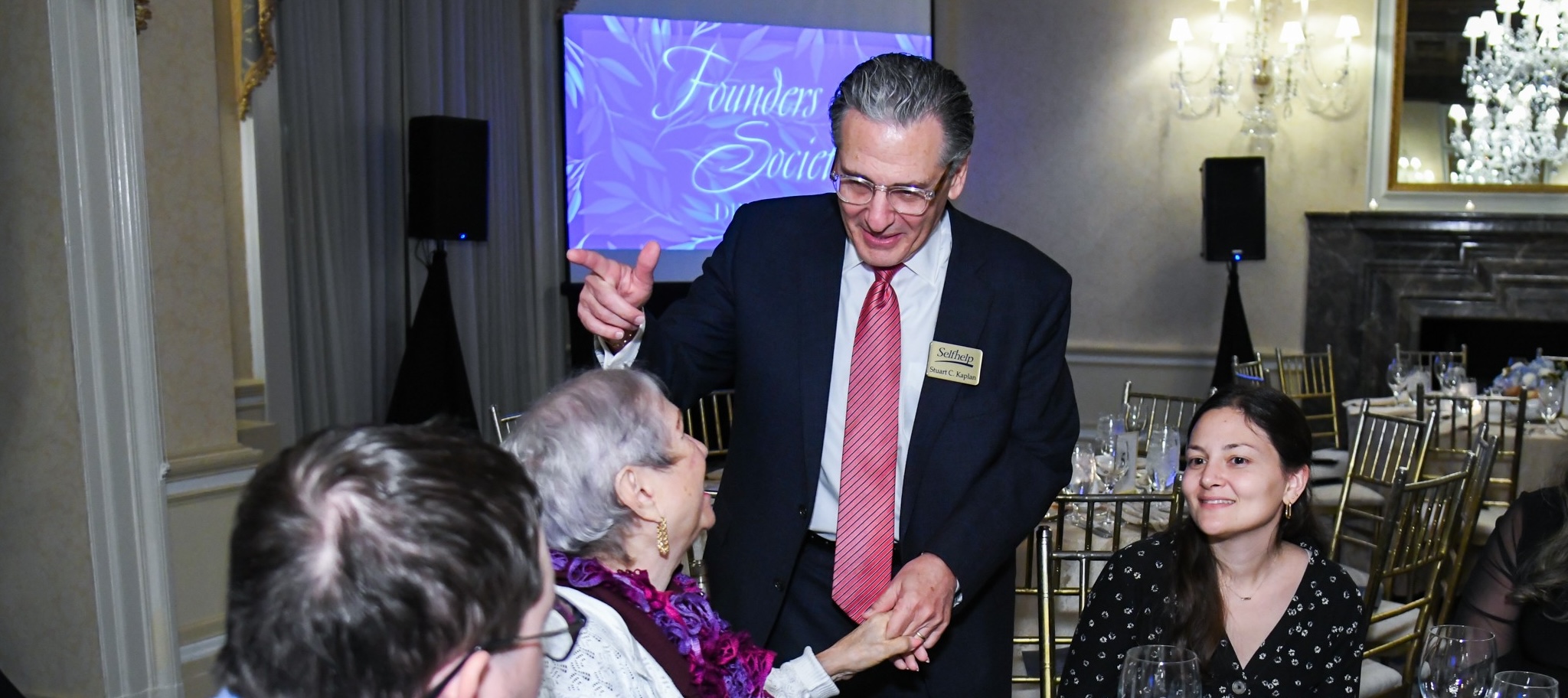
| Q&A with Stuart C. Kaplan
| A new book, Your Aging Advantage: The 7 New Stages of Aging, sets out to revamp the classic Eight Stages of Development developed in 1950 by German psychologist Erik Erikson. Authors Stuart C. Kaplan (CEO, Selfhelp Community Services, Inc.) and Marcus Riley (Founder, Booming Ageing Agency) contend that in Erikson’s model, “the psychological milestone for those over 65 was remaining focused and overcoming despair, which certainly discounts the rich active lives that people over 65 live today. It also fails to accurately reflect the lives over 65 that millions of people in their 40s and 50s are planning to lead.” In its place, they propose seven alternate stages:
- Young Adult (fully independent)
- Mid-adult
- Pre-Transition (beginning to look to their future with a critical eye)
- In Transition (in a decision-making period when it comes to work, home, priorities, the future, family and relationships, and even financial situations)
- Settled In
- Supported Living
- Elder
As the book makes clear, these stages are not linear. As we age, we might “flicker” from one stage to another, depending on our circumstances. Aging in America News spoke to Kaplan to find out more. This interview has been edited for brevity and clarity.
| You and your co-author have very different experiences. How did the book come together?
Marcus Riley, my co-author, is an aging services professional on the global stage. And there is an international association called Global Ageing Network. Marcus and I both served on the board, which represents aging organizations and NGOs throughout about 50 different countries. Marcus was representing Australia and I was representing the U.S. And so together we got to know each other and realized that age is something that needed to be addressed from a new perspective and a rethinking.
How does that fragmentation play out in practice?
There are multiple things that impact, whether they be medicine or social care or environment, that impact the way we age. And then of course, each individual has their own perspective based on from whence they come. But the fragmentation from a policy standpoint is something that society could address. If we could address the fragmentation, break down the silos and have people who are working with housing talk to people who are working in medicine, and people who are working in medicine talk to people who are doing social care and community services, then we can create an environment that would better serve the aging population.
Support independent journalism on aging
Who inspires you?
There are tens of thousands of older adults that we serve at Selfhelp Community Services. And It is their resilience every day at ages of 80, 90, 100 plus during everyday life, and also their thirst for education, for learning, for interaction, for being vibrant parts of the community that inspire me routinely Selfhelp is celebrating its 90th anniversary this year. We serve a broad swath of people all over the city and on Long Island, turning to us for assistance with social care, social interaction, access to medical care or with housing. In all of those regards, we are able to help each individual live independently and with dignity. Those two keywords are important for everybody at Selfhelp, over 2000 employees, to understand that that is what we are here to do every day for each individual, help to support their independence and dignity.

What did you learn from the pandemic? How did your organization change? How did you adapt?
The pandemic demonstrated the resilience of older adults. Many were impacted. Although we were interacting with so many of our clients remotely during the pandemic they so often would ask our staff, who would be decades younger, “How are you doing? Are you okay? Is there anything I can do for you?”
We created a Virtual Senior Center where we connected thousands of people over an internet platform enabling us to have people stay connected to their communities and us during the pandemic. What we took from that is a continuing program and now have promoted it statewide, as well as into other states.
How do you define dignity, as opposed to independence?
Independence is more about getting out, being on your own, and going about life as you would like outside of your home. Dignity is being able to make choices that affect your life and making those choices of your own free will based on the potential that you have. And potential has its own components. It could be financial potential, it could be physical potential, medical potential, where do you sit in a family structure and being able to be involved as you wish. Individual choice has broad implications for policy, services and how life is live at any stage.

From a policy standpoint, what do the seven stages of aging mean?
I was honored to be selected by New York Governor Hochul to serve on her Master Plan on Aging stakeholder committee. We looked at the environment, services, finances, workforce, and other major topic areas. One of the takeaways we had is that we could be rich in resources and rich in services, but if we don’t coordinate those services, and if each of those services is a silo unto itself, then it is providing a service, but not a holistic service. And so in the book, we refer to “a whole of aging” approach to providing services to older adults. That means looking at housing, looking at communities, looking at social interventions and how all of those fit together. It would be good to organize the heads of areas into a cabinet that considers whole of aging ideas that intersect and are cross-functional and then move them forward in a holistic way.
What is the significance of the concept of “aging on pace,” which Your Aging Advantage promotes?
There is a term of art in the aging industry called Aging in Place, and that came about, coined by Dr. Robert Butler, who was the first head of the National Institute on Aging. It was intended to pertain primarily to the nursing home industry at a time back in the early 1980s and suggested that people could age at home and receive those services in that environment rather than in a nursing home setting. It’s a great phrase and very well understood. So aging in place is where you live. The term that we have created is “aging on pace”, which is how you live based upon factors such as psychological, physical, mental health, environment. Taking those all into account, we can then each age at our individual pace, and thus we are all aging on pace. We would love for that message to get out there.
Leave a Reply