| How Duett Is Changing the Way Aging Services Get Delivered
| Mark Swartz
| This article was written with the support of a journalism fellowship from the Journalists Network on Generations, the Gerontological Society of America and the NIHCM Foundation.
For Darrell Johnson, a case manager at CICOA — the Area Agency on Aging serving central Indiana — the old way of connecting elderly clients to home care services was a paper-and-phone-call slog that could eat up a week of his time.
“I would have to figure out what companies provided assessments,” says Johnson, who has spent eight years at CICOA and more than four decades in social services. “I would have to call each one, write down the information — their email, their phone number — compile all that, type it into an email, and send it to the client.”
In Indiana, prior authorization assessments — an initial evaluation that determines what care a client needs and unlocks a first round of state funding — are required before attendant care kicks in. Attendant care is the ongoing hands-on help, such as bathing, dressing, or meal preparation, that follows. The manual process of finding prior authorization providers wasn’t just slow; it left clients choosing from whatever slim options a case manager happened to be able to track down, rather than from a full picture of available providers.
How to support independent journalism on aging
Johnson has been using a platform called Duett for two years now, and he doesn’t mince words about the difference it has made. “Duett just makes my life ten times easier,” he says.

Speed Dating for Social Care
Duett is a referral marketplace — a platform that sits between Area Agencies on Aging (AAAs) and the home care providers they contract with, automating a matching process that was previously done through directories, phone trees, and guesswork.
It began when Jonathan Haag, CICOA’s vice president of innovation and administration, and his colleague Chad Bales recognized that case managers were spending enormous time chasing providers one by one, often coming back to clients with a single option — or none. The research team set out to find an existing tool that could solve this. When nothing adequate existed, they built one.
Courtney Baldridge, Director of Business Development at USAging — the national membership organization for the country’s 618 Area Agencies on Aging — describes it in terms that resonate across the industry: “It’s almost like speed dating with your service providers to see who’s the best person to serve Mrs. Jones as quickly as possible.”
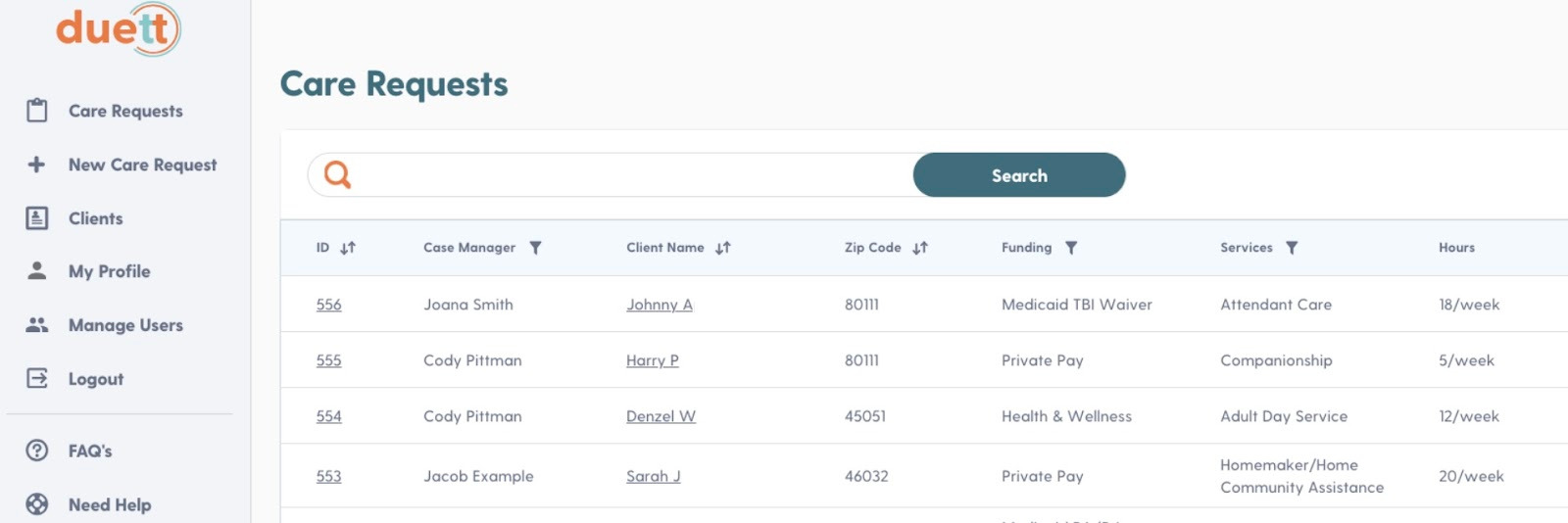
The workflow is simple. A social worker logs into Duett, enters the client’s zip code, service needs, and key details — hours required, medical considerations, even whether there’s a dog in the house — and submits the request. Within 48 hours, every licensed and vetted provider in that geography who has capacity responds directly through the platform. The case manager then presents the list to the client, who makes the choice.
“A thing that used to take me maybe a week now takes me 48 hours,” Johnson says. “All I have to do is press a button, collate those companies, print it out, and send it to my client. It has reduced my workload exponentially.”
USAging has quantified the gain more precisely: Duett saves approximately two hours of case manager time per client. In a field perpetually stretched thin, that makes the difference between serving more people or turning them away.

Built by and for the People Who Use It
One reason Baldridge and USAging were drawn to Duett is the provenance of the product. “We particularly liked Duett because it was developed in partnership with an AAA,” she says. “As that product was built, they truly understood the needs of the AAA. When other people go out and create innovation for social care entities without social care entities at the table, it’s not quite as impactful.”
That grounded design philosophy shows up in the details. The output a case manager sends to a client is printed in bold, legible type with complete contact information. Providers can filter referrals by zip code to build geographically efficient schedules for caregivers, helping agencies offer workers fuller hours in tighter radiuses. Haag calls it “playing Tetris with work schedules.”
The platform also generates data that simply didn’t exist before. Home care agencies can see demand heat maps, track which referrals are going unmatched in rural areas, and make staffing and expansion decisions based on real market intelligence.
Cody Pittman, CEO of Duett, recalls one Indiana agency that noticed through Duett that demand for skilled nursing in their region was going unmet — and went on to open a skilled nursing division they might never have known was viable. Another agency used the geographic data to open four successive offices across Indiana, each one guided by where the referrals were clustering.
“If you’ve got a person sitting around waiting for a phone call, that’s not a scalable activity,” Pittman says. “Versus if you have a dashboard that says, here are all the leads, here are all the opportunities, here’s all the demand for my business — that’s data they’ve never had before.”
According to Haag, “Duett allows more people to get to work in the service of others.”

A National Moment
Duett launched at CICOA in 2021 and has since expanded to five AAAs in Indiana, with approximately 500 home care agencies and around 10,000 referrals processed through the platform. USAging announced a formal partnership with Duett earlier this year to help bring the tool to AAAs nationwide, with pilot slots for agencies outside Indiana currently being filled.
The timing is not incidental. Federal Medicaid cuts loom as a near-term threat to the funding that undergirds much of the care the AAA network provides. Baldridge is direct about what that means for organizations already operating on thin margins: “If we can drive cost savings to an agency, they can turn around and do more with their existing resources.”
For Baldridge, who stumbled into aging services by accident more than two decades ago and never left, the stakes are personal. “These people work so hard every day to serve the at-risk in their communities,” she says. “They are my heroes.”

For Johnson, who is 63 and jokes that he’ll soon be eligible for some of the services he arranges for others, the platform’s appeal comes down to something simpler: it works, and it works for the people who matter most.
“They’re family,” he says of his clients. “We’re all getting to the point where sooner or later we’re going to need someone to help us as we grow older.”
USAging will showcase Duett at its annual conference in San Diego this July. Area agencies interested in learning more can reach out through the USAging website.
Mark Swartz is the founder of Aging in America News.
Leave a Reply