| An Aging-in-Place Factor We Don’t Talk about Enough
| Observations of a Newly Minted Older Person
| Louis Tenenbaum
I had second thoughts when I cleaned my gutters recently. I just didn’t feel comfortable. Frankly, I was fearful climbing off the ladder onto the roof and felt even more trepidation stepping back onto the ladder. I have to admit, my balance is just not what it used to be. There I am, telling myself how stupid this is. After all, I am one of the 72-year-olds I warn not to go onto ladders in my consumer presentations. I am on a crusade to make people aware that falling must be avoided to preserve your life and dreams. There is no way to explain this making any sense.
Coming to terms with this reality was especially hard because I am a carpenter. I used to stand easily on a 2×4 on a second story wall 20 or more feet off the ground, reaching out for trusses from a crane, or pulling long 2×10 joists up from the hands of a fellow worker. Turning, bending, nailing. I loved it. I was confident in that job. Now I see how risky that was. I wouldn’t consider it again.
Support independent journalism on aging
But here I was cleaning my gutters. My justification is that finding and engaging someone to do what I have always done easily is a bigger pain than just getting it done. In fact, it took only an hour or so…surely less time than finding someone. And just enough time to fall and destroy my so-called life. Luckily, nothing bad happened, but I recognize this moment as a step in my own aging journey.
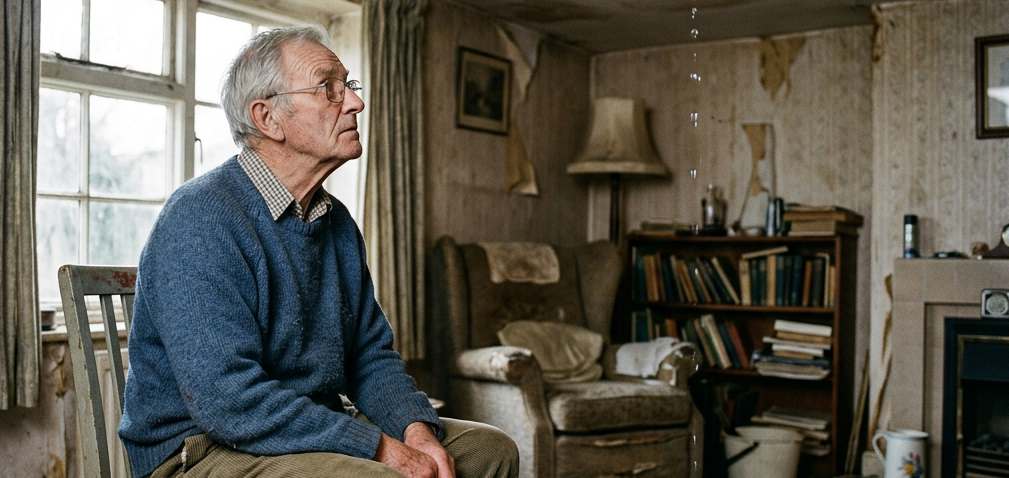
This column is prompted by recent reporting that older people get less for their houses than younger people. Researchers at Boston College’s Center for Retirement Research found the gap starts at age 70 and widens with age. By 80, sellers get about 5% less, or $20,000 on a $400,000 home. I believe deferred maintenance is a big part of it. Older folks can’t or don’t keep their homes up and it results in reduced sales price or delayed liquidity while they resolve maintenance issues. The researchers credit home condition with only about a tenth of the gap and point instead to older owners selling off-market or to investors. I think that undercounts it. Listings rarely mention a rotted subfloor, and buyers and realtors might shy away from a house that needs work. But those aren’t the only negative impacts. Deferred maintenance also impacts caregiving routines, and crisis repairs cost a lot more.
The problem with care routine interruption is most acutely witnessed in caring for those with dementia. Routine eases the dementia care experience. Surprise visits, like strangers moving through the living room over a couple days to replace the furnace are a problem. One caregiver we interviewed told us of her experience after taking her mom away for a few days when evacuated for California fires. Mom didn’t recognize the house (luckily undamaged) at all when they returned. That is a big problem. And it is not rare. In our home maintenance survey, 11 of 15 family caregivers of people with dementia said a maintenance failure, such as a furnace breakdown or a plumbing leak, had disrupted the household routine. In five cases, the person with dementia had to move out, three temporarily and two for good.
Proactive maintenance also costs less. By conservative estimates, it saves 20% compared with waiting for things to break. And because experts recommend budgeting 1%–4% of a home’s value for maintenance each year, those savings add up fast. On a $400,000 home, a 2% budget comes to $8,000 a year. Saving 20% of that is $1,600 a year, or $8,000 over five years: a full year of maintenance, paid for. Yet few homeowners take this approach. In our survey, more than a third of homeowners could point to a repair that cost more because routine maintenance was skipped. But who to hire is a problem. (See my gutter clearing story above.) Nearly half the homeowners in our survey do no regular maintenance at all, and the most common reasons were not knowing how and not knowing a reliable person to call.

How to know, and tell them what to do is also a dilemma. I have a bone to pick with companies that offer a maintenance contract for x number of hours per month. It is not the price or the work that bugs me. But most often they expect the homeowner to come up with the monthly ‘honey do’ list. This is tantamount to telling your doc what blood work or other tests or vaccines you want. Or telling your mechanic what to do on the 50,000-mile checkup. It is not the homeowners’ expertise. How do they know? Two-thirds of the homeowners we surveyed said they would do more maintenance if someone told them what their particular house needs.
We can look to public, commercial and multi-family buildings for a path. Bigger properties have regular inspections, budgets, capital reserve funds, and maintenance routines. The buildings are analogous, but all of these building owners have systems in place for avoiding breakdowns, with inspections and routine maintenance built in. Think how systematic your dentist is when carrying out their investigation of mouth conditions. We need that for all homes. It will avoid crisis, crisis costs, save money, provide peace of mind, while preserving value and liquidity.
All in all, though almost completely unrecognized, home maintenance is a critical care and cost factor in successful aging in place. I invite a robust conversation on how to resolve this. Reach out to me on LinkedIn to discuss.

Louis Tenenbaum is a longtime advocate for aging in place, co-founder of the HomesRenewed™ Coalition, the HomesRenewed™ Resource Center, and HomesRenewed Ventures, LLC and a nationally recognized expert on home modifications that support independent living. Discover more columns in this series.
Leave a Reply