| Part I. A care-forward approach to welcoming death
| Mélina Magdelénat
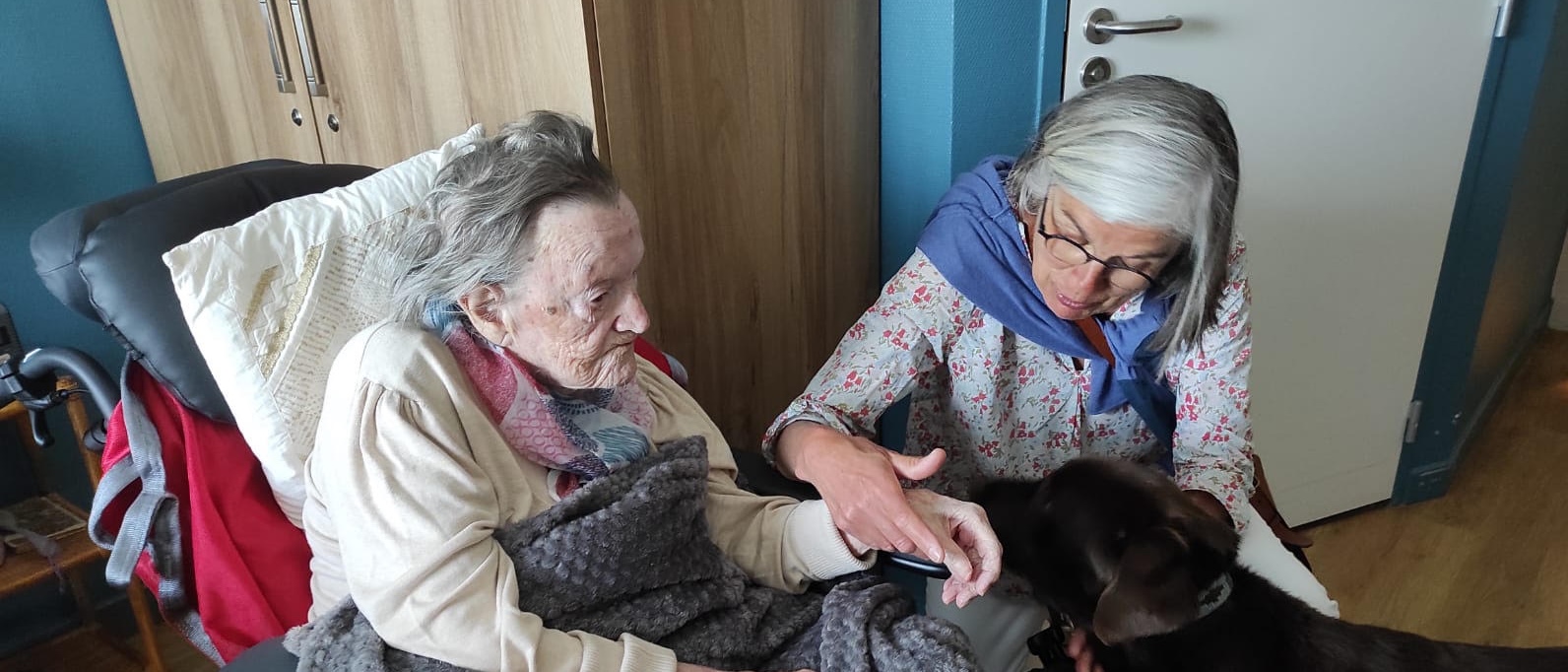
| François Génin co-founded Voisins & Soins (Neighbours & Care), a French nonprofit that accompanies people living their final months and days at home. Small teams combine healthcare professionals and trained volunteers to provide holistic end-of-life care within a person’s home, while also providing respite and support to their loved ones. Their profoundly important work shows that a care society would transform the way we experience grief, and the way our institutions respond to death.
Voisins & Soins represents a model for adapting and scaling caregiving anywhere people need it — which is to say, everywhere. They drew inspiration from an experiment that started in India and is now being integrated within the national healthcare system. Its success rests on proving that community-based care that centers human relationships and dignity as much as it does medical outcomes is both desirable and affordable.
And who knows? It might even inspire a reader to start their own version of Voisins & Soins, the way an article inspired Génin to begin his journey.
How does an aging population correlate with the needs for palliative care?
Today, as the population ages, needs are growing significantly. Public statistics forecast an average of more than 790,000 deaths per year from 2044 onwards, whereas between the 1970s and the end of the millennium, that figure was closer to 545,000. Coverage has improved since 2015, but not proportionally to that increase. Within ten years, at least 200,000 people will not be supported, or not adequately supported, at the end of their lives.
What inspired your work?
The Neighbourhood Network in Palliative Care, an initiative of the Pain and Palliative Care Society (PPCS) launched by two doctors in the Indian state of Kerala. Having spent several years accompanying people at the end of their lives in clinics, M. R. Rajagopal and K. Sureshkumar had observed both the great human value of this work and the impossibility of scaling it nationally. It was simply not financially achievable.
Support independent journalism on aging
They therefore devised an experimental model grounded in the observation that, outside the roughly 10% of medically critical situations for which the hospital is the right response, death is not primarily a medical problem. It can perfectly well be handled at home, by drawing on the dense networks of solidarity that exist within local communities.
The two clinicians went out and canvassed every actor likely to contribute to such a mobilization: neighborhood organizations, solidarity groups, Communist Party cells, all religious denominations, municipalities.

Within a decade, 10,000 volunteers had been trained. The PPCS approach obviously included a medical component — but the key was inverting the paradigm. Rather than inserting volunteers into a medically centered framework, it anchored a medical component within a grassroots mobilization.
How do you adapt this model to the French context?
According to the then head of oncology at the WHO, Dr. Jan Stjernswärd, it is not only the best model for emerging countries but the only one with which Western countries can aim for reasonably decent coverage. It costs considerably less, and it keeps people whose situation is well-suited to home care from going to the hospital out of a lack of alternatives.
I set about adapting it in 2015. This mattered because the relationship to the body, the place of medicine are not the same in France — in India, volunteers are trained to bandage wounds, for instance, something that here is reserved for professionals. My ambition was that this approach, without contradicting what already exists in palliative care, could complement it and offer a form of support oriented towards the home, rooted in a mobilization of civil society at the local level.
How do the Voisins & Soins teams work?
They are neighbourhood teams (in rural areas, they cover a few villages each) of around ten people. They include on average seven volunteers who commit to half a day per week, a doctor for half a day, a nurse for 1.5, and a psychologist for a few hours. At the scale of a town, we need a minimum of two teams, ideally three, which allows us to accompany 40 to 50 people per year for an average of four months each.
This human-scale composition allows for the experience of professionals and volunteers alike to be meaningful and lively. That is the starting point for everything else.
Team life takes shape through a weekly coordination meeting — the equivalent of a medical staff meeting. Its primary purpose is to foster a team spirit, because we do not have the natural cohesion that a shared workplace like a hospital provides. Our teams are always actively caring for five people at any one time, and each one involves the whole team: we never entrust someone to a single person. The meeting is a moment of exchange so that everyone is on the same page, in a logic of shared responsibility that encourages collective intelligence.
Why is this shared responsibility so important?
It’s the heart of our organizational culture.
Palliative care encompasses four dimensions: the medical, of course, but also the psychological, the social, and the spiritual. This last one involves welcoming the metaphysical questions that death inevitably raises, about life and what comes after it. Some lean on a religion for this; others do not, but the questions arise nonetheless. It is important to make room for them.
These four dimensions are intimately connected. Many people in palliative care suffer from anxiety or sometimes severe depression, and these conditions can lead to up to twice the level of medical care consumption, and significantly increase recourse to emergency services.
Because of this interplay, it is essential to build a management culture that allows medical and non-medical skills to work together smoothly. This is not self-evident: it’s not easy for a volunteer to speak up in a team meeting after the doctor, and to feel fully legitimate in what they bring.
Mélina Magdelénat is the founder of Cara, a French organization dedicated to building better care systems. She also writes about innovative care models in her newsletter, The Fifth Wave.
Leave a Reply