| Q&A with Vivalon’s Kaushik Roy
| In a world where services for the aging tend to be siloed, addressing multiple needs in one place requires foresight and a willingness to collaborate. That’s what Vivalon is all about. Joel Shapira, executive director of the American Society on Aging’s On Aging Institute, describes this Marin County, Cal. organization as “proof that aging well isn’t just an individual or family responsibility — it’s a community one. Their integrated model shows what’s possible when a whole community stops treating care, connection, and housing as separate problems and commits to a more holistic solution.”
Mary Furlong adds, “What [CEO Kaushik Roy] and his team have created brings a diverse, intellectually engaged community together. Communities around the world planning for the boomers and beyond should take a close look at the Vivalon model. Longevity hubs are one of the most important trends that came out of our recent What’s Next Longevity Venture Summit.”
We talked to Kaushik (/koh-SHEEK/) Roy about Vivalon’s model and how other communities might learn from it. This interview has been edited for length and clarity.
Why and how did Vivalon arise in Marin County?
There’s a stereotype that we have to overcome that Marin has a lot of wealthy folks, which it does, but it makes invisible a lot of folks who do not fall into those categories. Nearly one in three people live alone. There are 7,000 seniors in Marin County that are looking for affordable housing. And all their kids have moved away because they can’t afford to live here. You would be surprised how many folks are all alone and they look forward to their Meals on Wheels volunteer or driver because they need the food, yes, but that’s the only source of social connection or companionship they get.
Take our reading survey for a chance at a $25 Amazon gift card

How do Vivalon’s programs and services come together?
We have four floors of Section 8 housing. Housing is the biggest issue for aging folks. They are the most rapidly growing sector of the marginally housed population. After housing, I’d say there are three things that really have to be addressed. One is food. One out of three seniors in Marin are hungry. The second is falls prevention. One out of three seniors that go to the hospital, it’s because of a fall. And the third is the social connection and reducing isolation.
How does Vivalon address that epidemic of loneliness?
We live in a time where everything is about efficiency and nothing is about empathy. And because of that, just the basic respect and decency and kindness we all are entitled to is not given as much as it should be. Vivalon has a human or person-centered approach. One of my favorite lines is by the author Zora Neale Hurston. “There is no agony like bearing an untold story inside you.” We all have our stories. Regardless of age, we all just want to be seen and heard. We’ve been doing a lot of intergenerational work, with teenagers interacting with people in their eighties, and they just start talking. And a couple of things they’ve discovered that they have in common. One is that no one takes them seriously.

What role does organizational culture play?
If you’re going to have a place for social connection, what you’re really asking for is, How do you create community? And the way you create community is, you have to be very inviting and welcoming and know that every single person has a role in that place. And I think that’s a really cool part of Vivalon. “Connection Works Wonders” isn’t just our tagline; it’s one of my core values. Everyone deserves to have at least someone, and too many of us have no one. And that’s especially true for our senior population.
How does architecture and design advance Vivalon’s goals?
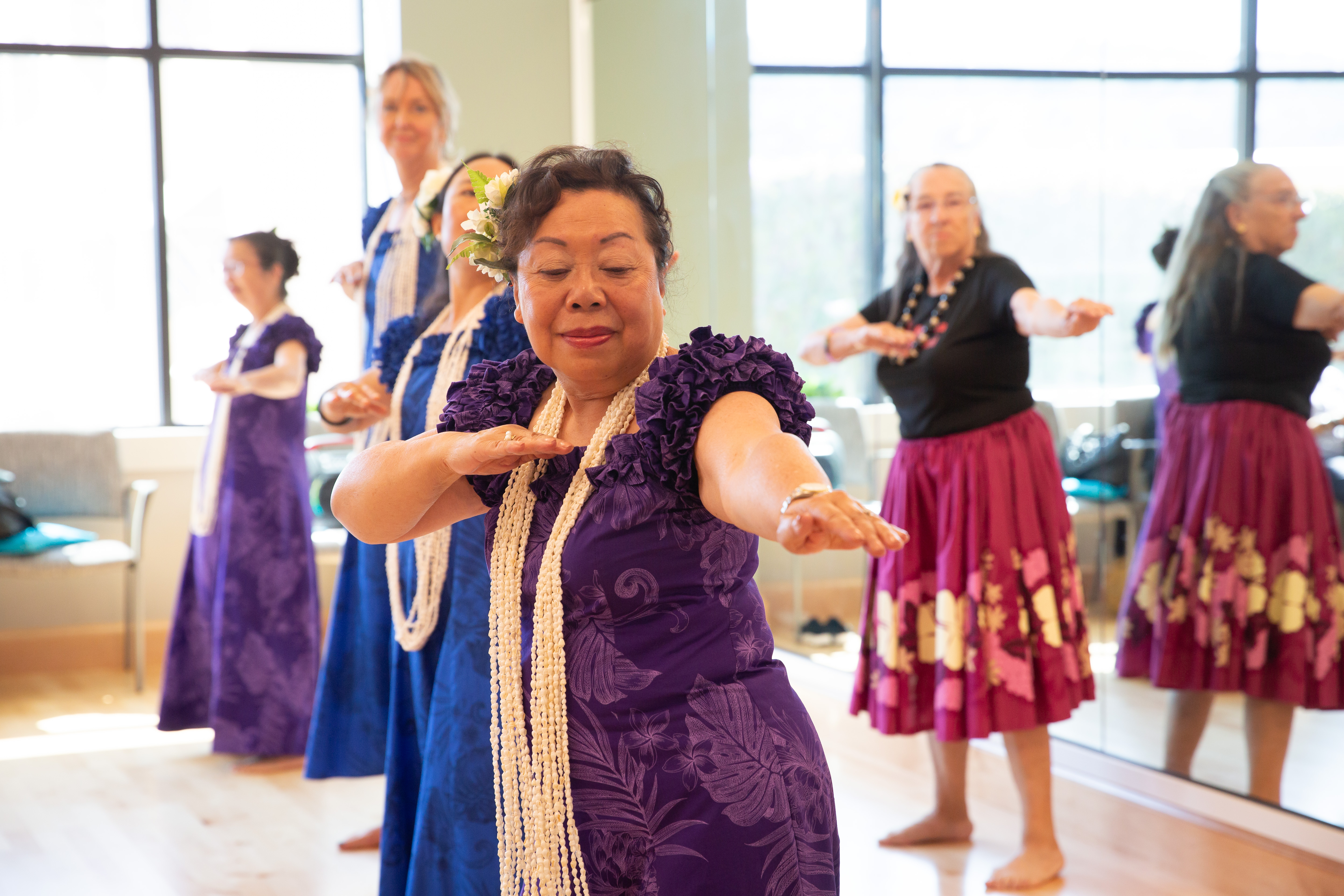
This building is actually one of the reasons I wanted to join Vivalon. There was research done basically where you can have the same quality of doctors and nurses. But if you put them in, if you will, a rundown clinic somewhere versus a really state-of-the-art hospital, people are going to assume they get much better care in the state-of-the-art hospital, even if the quality of services are comparable. And I think that’s true for folks who are often felt invisible, is that they want to go somewhere where they’re recognized and they’re honored. It is a community, and there’s something for everyone. We have everything from falls prevention to art classes to death cafés, which are just a structured way for people who want to talk about their death to come together.
What factors made it possible for this to happen in Marin County?
A lot of people stepped up to make this happen. There was a lot of generosity involved. This was actually about a decade in the making. The idea of this came around 2014, 2015. And there was a huge hiccup with Covid. Originally, the idea was to raise $10 million, and that figure ended up being $17 million because of the prices of everything increasing.

What advice do you have for communities that might aspire to replicate what you’re doing?
To really support the aging community, it has to be a community response. You have to have a tax base, you have to have corporations or philanthropists who are going to be generous. It has to be a full community effort. And the building is a really good example of what happens with government, philanthropy, and the private sector. You have to have a commitment from the community. Now in our situation, the majority of our funding for our two floors was primarily from people and foundations, but the majority for the housing comes from government involvement. What’s tricky is, especially right now, with politics being the way they are, is it’s hard to have a public-private partnership if there’s no “public” in that equation.
What’s next for Vivalon?
We need to figure out how to get managed care and the insurance companies to the table, because they are the ones that are reaping all the benefits from what we do. Prevention is always a better investment than treatment. And they were not really involved with our building. So you have the government, you have generous philanthropists, but the people who are actually saving the tens of millions of dollars each year need to reinvest in the systems that are helping them as well.
How did you get into this work?
I always acknowledge that we get to decide how we make a living. And that’s a very big privilege because a lot of people in the world would not even recognize that as a concept. And for me, when I thought about this, it came down to: what would be most meaningful for me would be to work toward a society that doesn’t leave anyone behind. One could argue seniors aren’t even left behind because they weren’t to the front in the first place. Aging is arguably one of the public health top priorities of our time. And I’m not sure how well we are doing at the moment. I think we can safely say we’ve left a lot of room for ourselves to grow and succeed.
Leave a Reply