| Malcolm Brooks
| Aging in America News publisher Mark Swartz and I connected this year at On Aging 2026, organized by the American Society on Aging (ASA). The conference theme—“The Power of Belonging”—could not be more urgent. We’ve been living in the grips of a documented loneliness crisis for years, but the sheer scale of the health and economic catastrophe it is poised to wreak on our graying society is just now fully coming into focus.
Social isolation is not merely a sad emotional state; it is a clinical hazard. It attacks our minds, increasing dementia risk by 50%. It punishes our bodies with a mortality impact equal to lighting up 15 times a day. Not even our collective wallets are spared, with loneliness tacking an excess $6.7 billion onto Medicare spending annually.
As research continues to churn out these grim metrics, the chorus describing loneliness as a public health emergency has expanded to include the CDC, the NIH, and the U.S. Surgeon General. Forty percent of adults over the age of 45 struggle with chronic loneliness. They are acutely in need of a solution.
Facing this peril, “belonging” feels like the obvious, intuitive antidote. We know empirically that belonging lowers stress, boosts immunity, and extends lifespans. Great!
So what is belonging, again?
ASA had the foresight to ask conference attendees to describe what belonging meant to them.
Asked directly, attendees offered familiar truisms—“connection,” “included,” “accepted.” Satisfyingly fuzzy definitions that, upon reflection, clearly describe outcomes of belonging, not the experience itself. Thus, the deeper question persists: What is actually happening in the moments when belonging is felt?
And how can answering this question support mission-driven organizations that serve older Americans?
Support independent journalism on aging
When we looked beyond words, a clearer pattern emerged.
Consider the riddle of what these images have in common:

The pelvis, an internal structure that supports us and keeps us upright, fully exposed by x-ray.
A majestic banyan tree, its tangle of nourishing roots unearthed and laid bare in sunlight.
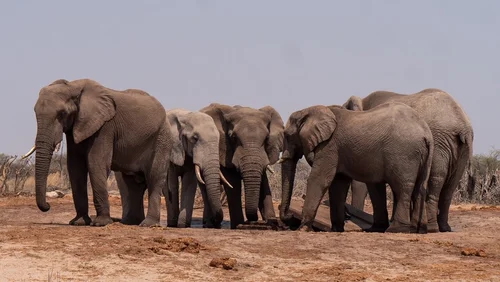
Elephants huddled in an intimate circle of kinship around a small watering hole.
Asked to define their experience of belonging in images—using ZMET, a research technique that harnesses metaphor to reveal unconscious thought—attendees selected these pictures.
So why did their images zag from the expected—diverse high-fiving teams—to these intriguing snapshots?
Collectively, they portray a unique function of belonging: the unseen structure holding everything together. Like pelvic bones, tree roots, and herd behavior, belonging in action acts as a social scaffold, enabling us to move through life without the fear that we will collapse when our own abilities falter. It’s a promise that others will catch us.
But there’s an even deeper story when you observe where belonging originated in the “before” state of these images. Packed under flesh. Buried in dirt. Shielded by colossal animals.
If belonging is something we so deeply desire, why do we go to such great lengths to conceal what makes it possible?
Belonging is not defined by being seen, but by the safety to reveal what is usually kept invisible.
To reveal. Yes, the benefits of belonging require a fearful sacrifice: exposing our true selves. And being exposed is terrifying.
Vulnerability is pleasantly defined as “the state of being open to the possibility of being attacked or harmed, either physically or emotionally”. Even if we long to belong, our natural risk avoidance leads us to mask, code-switch, and cover, even to embrace belonging’s dark alternative—“fitting in”. So what if we conform and sand down our awkward edges (at the cost of never being truly known). Isn’t that polite? Isn’t it close enough?
Brené Brown asserts a clear rebuttal, “true belonging only happens when we present our authentic, imperfect selves to the world, our sense of belonging can never be greater than our level of self-acceptance.”
Through mutual exposure, we transcend the similarity trap, and receive judgment-free validation of our deepest selves, granting reciprocal acceptance of others in their raw states.
Turning our empathetic x-ray to the audience at hand, the implications for the aging sector extend beyond reforming the “two truths and a lie” icebreaker. Every older adult brings a lifetime’s worth of experience and love, a resource that can either enrich their environment, or be shamefully concealed.
We can reform organizations that think they have “belonging” when they really have membership. We can foster environments when older adults feel safe to proffer their authentic selves and find connection.
I think of my own grandmother, an educator who, at 80, savors her unretirement as a middle school teacher. The belonging she enjoys is among lifelong colleagues who can commiserate with the joy and struggle of shepherding the next generation at a very human level.
This is a mission that is worth researching and investing in. When vulnerability is met with protection instead of judgment, it becomes connection.
And as one ZMET participant sagely noted, “Vulnerability when shared, turns into empowerment.”
Malcolm Brooks is Senior Insight Manager at Olson Zaltman. He is also a trivia pro, appearing on Who Wants to Be a Millionaire and ABC’s “The $100,000 Pyramid”
Leave a Reply