| Observations of a Newly Minted Older Person
| Louis Tenenbaum
| Part 2 of a 4-part series: The Only Test That Matters
A home that works is worth having whether you stay 2 years or 20
The same issue has come up twice recently, from very different directions. It’s a basic one — and persistent. This four-column series is my attempt to clarify it.
The problem is that we approach building backwards. We wait for a diagnosis, an injury, or a moment of crisis — and then we respond. Since remodeling takes time to be done well, urgency undermines the functional process.
And all along, we celebrate aging in place while continuing to design and build homes that fall short in the critical details. They work right up to the moment they’re needed. That’s when the details start to matter.
Timed for the 2026 American Society on Aging and National Aging in Place Council meetings, this series looks at that gap — and what we may do to fill it.
Read part 1
Read part 3
Read part 4
A friend asked me to review plans for a remodel recently. Early 70s, both active, he and his wife both had recent back surgeries.— the kind of situation where people have already learned, firsthand, how quickly mobility can shift. They were not naive about what they were planning for. They had chosen a designer with some familiarity with aging-in-place principles. They felt they were in good hands.
The drawings told a different story.
The shower was beautiful — no step entry, clean lines, exactly what you’d want to see. It also had a fixed glass panel blocking roughly half the entry. The handheld shower was there, mounted on a standard slide bracket rather than a true grab bar, and positioned for someone standing at full height. The built-in seat was several feet from the controls, which is a nice feature, if you enjoy getting up to adjust the temperature. The washer and dryer were stacked, which saves floor space efficiently but also requires lifting heavy wet laundry up and over repeatedly, which is tough no matter your age. The two vanities were 36 inches high and provided no knee space, making them elegant and completely unusable from a seated position.
Support independent journalism on aging
None of these decisions is, in isolation, catastrophic. Together they describe a home that will work very well right up until the moment it needs to work differently.
When I raised the question of grab bars to the designer, the response was one I’ve heard before, offered here almost verbatim: “There is no need for grab bars at this time IMO, but there will be sufficient blocking in the walls for future grab bars in the shower enclosure and on the wall adjacent to the toilet when the need arises.”
The homeowners, to their credit, disagreed. They wanted the bars. They understood something the designer had not quite absorbed: that “when the need arises” is not a reliable planning horizon.

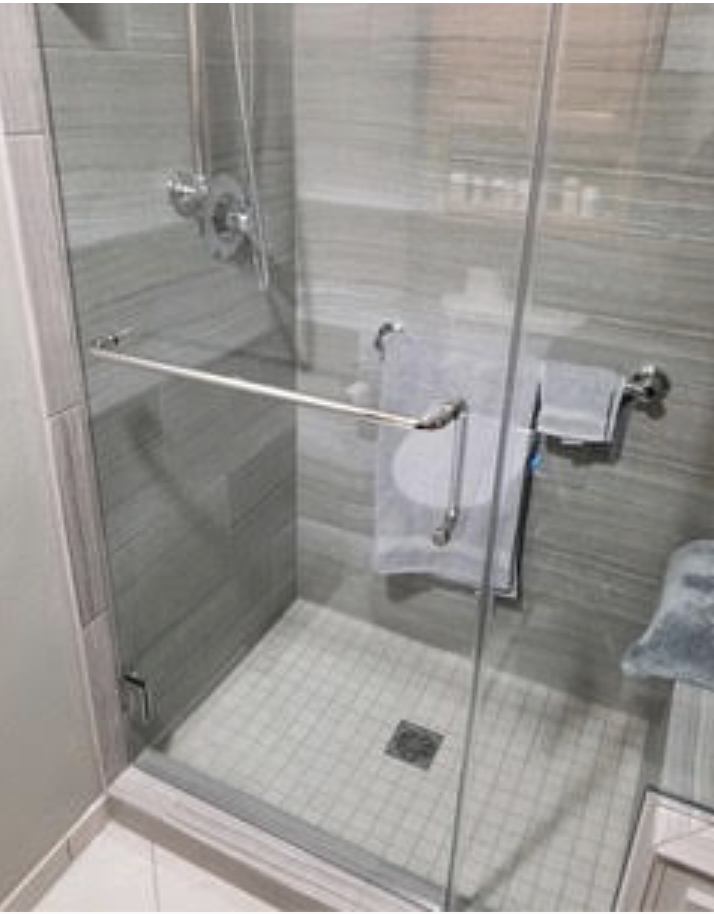
A second example arrived, as these things do, on LinkedIn. An accessibility contractor had posted images of a completed wide no-step shower, clearly proud of the work. The beautiful shower had sliding glass doors blocking half of the opening. The doors featured long horizontal bars running their full width, positioned exactly where a person might naturally reach for support. The bars were towel bars — decorative, not load-bearing, and mounted to a surface that moves. When someone pointed this out, the response was cheerful and certain: “They’re able-bodied now. If they need it later, they can remove the doors.”
Later. Always later.
Later is a genuinely convenient time. It’s also, as it happens, when the budget is gone, the contractor has moved on, the walls are closed, and the person who needs the modification is least equipped to manage a construction project. Later is when a temporary inconvenience becomes a permanent barrier. It is not, despite its reputation, a good time to fix things.
The details here are worth noting. A no-step shower with half its entry blocked is not an accessible shower — it is an accessible-looking shower, which is a different thing and in some ways worse, because it creates confidence that isn’t warranted. A bar that cannot bear weight is not a safety feature. It is a liability dressed up as one. I cannot figure out why you would want a built-in seat out of the controls. You can’t spit in a tall vanity from a seated position.
This is not a fringe problem or an occasional lapse. It is the normal condition of a market that has learned the vocabulary of accessible design without absorbing what the words mean in practice.
We are building homes that signal “aging in place” while quietly ensuring that aging in place will be harder than it should be. They work, and they will continue to work, right up until they don’t.
Which is, unfortunately, exactly when the details start to matter.

Louis Tenenbaum is a longtime advocate for aging in place, co-founder of the HomesRenewed™ Coalition, the HomesRenewed™ Resource Center, and HomesRenewed Ventures, LLC and a nationally recognized expert on home modifications that support independent living. Discover more columns in this series.
Leave a Reply