| Your 401(k) is compounding right now. So is your muscle loss.
| Elisa Feng
| Reposted with permission from the “Age Anywhere” Substack
| Every holiday, without fail, some auntie or uncle corners me with the same question.
“When are you having children?”
I am in my late 30s. The answer is I am not. And the moment I say that, the follow-up arrives just as predicted.
“Then who is going to take care of you when you are old?”
Nearly one in six Americans over 55 has no children, and that share is growing. I will be one of them.

For years I had a ready answer. I would work hard enough, make enough money, and check myself into a good place when the time came. It felt like a plan.
Then my work took me into healthcare, and I found myself face to face with the senior care industry for the first time. I could not look away. The median cost of assisted living now exceeds $70,000 a year. Memory care runs higher. A private room in a skilled nursing facility crosses $100,000 in most markets, and that is assuming a bed is available, and assuming the quality is acceptable, which anyone who has navigated this knows is far from assured.
The plan I had been carrying quietly was not a plan. It was an assumption built on a system I had never actually looked at.
So I looked.
What I found unsettled me. Not just for the people already living through it, but for what I could be quietly inheriting if I kept treating this as someone else’s problem. I started writing this newsletter to understand it better.
I wanted to understand what actually determines who gets to stay home and who does not. What the science says. What the data shows. What is still buildable if you start early enough.
One note before we go further: this piece is about prevention and the variables research shows are within your control. It is not a guarantee. Dementia does not care how well you trained. Some people do everything right and still end up without good options, because the system is broken in ways individual action cannot fully fix. If you are already in a hard situation, this is not a judgment. This is information sharing for the people who still have time to act on it.
The baseline we inherited
Before getting into the science, it is worth naming the conditions most Americans are navigating without knowing it.
Adults in the US get 57% of their daily calories from ultra-processed foods, compared to 14 to 38% in European countries. Only 13.9% of Americans over 65 meet federal guidelines for both aerobic and muscle-strengthening activity. Roughly a quarter of older adults are socially isolated. US life expectancy sits 4.1 years below comparable countries despite spending nearly double per person on healthcare. Preventive care has declined as a share of that spending from 3.7% in 2000 to 2.9% in 2018, and while per capita preventive spending briefly spiked during COVID, it fell back to $649 by 2022 even as total health spending continued to rise. More money into the system. Less of it pointed at prevention.

These are not personal failures. They are structural conditions. The food system, the built environment, the healthcare system’s orientation toward crisis rather than prevention. Americans are not lazier or less disciplined than people in countries that produce better aging outcomes. They are operating inside infrastructure that was not designed for this.
The metrics that determine whether you can stay home independently
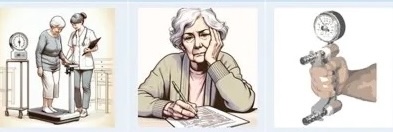
In 2001, Dr. Linda Fried at Johns Hopkins published what became the most widely used clinical definition of physical frailty. The Fried Frailty Phenotype scores five physical markers:
1. Unintentional weight loss. Have you lost 10 or more pounds in the past year without trying? Compare your current weight to where you were a year ago. If yes, this marker is present.
2. Exhaustion. Assessed with two questions from a validated depression scale: “How often did everything you did feel like an effort?” and “How often could you not get going?” If the answer to either is most of the time or all of the time over the past week, this marker is present.
3. Weak grip strength. Measured with a handheld device called a dynamometer. You squeeze it as hard as you can and the result is compared against cutoffs adjusted for your sex and body weight. Many gyms and physical therapy offices have one. Consumer versions are available for around $30 to $50.
4. Slow walking speed. Mark out 4 meters, roughly 13 feet, on flat ground. Time yourself walking it at your normal pace. Taking more than 5 seconds places you below the clinical threshold of 0.8 meters per second.
5. Low physical activity. Total weekly energy expenditure from all movement, not just structured exercise. Walking, chores, errands, everything counts. Clinicians use a structured questionnaire. A practical signal: consistently below 7,000 steps a day with minimal exercise across a full week.

Each marker is scored as either present or absent. Add up how many apply to you. Score zero and you are robust. Score one or two and you are pre-frail, meaning you are at elevated risk but the trajectory is still changeable. Score three or more and the clinical designation is frail.
The frail word carries real weight. Once it appears in your chart, it shapes surgical decisions, discharge routing, and care planning in ways most patients and families never realize are happening. If you move into a senior living community, a version of this same assessment determines your care level, which determines what you pay. The same markers that predict your independence also predict your monthly bill.
Among adults over 65 in the US, 15% are frail and 45% are pre-frail. Most of them do not know it.

Pre-frailty is the most important category in the prevention literature. It is the stage where the trajectory is still reversible. And the inputs that drive those five markers start accumulating decades before any clinician runs the test.
There is no routine screening recommendation for frailty in primary care. The system does not come to find you early. It waits for a fall, a hospitalization, a discharge meeting where someone uses that word and the options on the table quietly change.
Support Independent Journalism on Aging
What the research says to do, and why it starts now
Each of the five markers the Fried scale is a downstream output of something that has been accumulating for decades:
- Muscle loss drives weak grip strength and slow walking speed.
- Poor nutrition and declining cellular function drive weight loss and exhaustion.
- Sedentary habits drive low physical activity.
These are not separate problems. They are the same problem at different stages of the same process. The process starts earlier than most people think. Muscle mass loss begins in your 30s and accelerates significantly after 65, with losses of up to 8% per decade possible. It is silent. You do not feel it year to year. By the time a clinician measures your grip strength and walking speed at 75, they are reading the accumulated output of decisions made in your 30s, 40s, and 50s. The frailty score is not a verdict on old age. It is a receipt.

The federal standard is 150 minutes of moderate aerobic activity per week plus two days of strength training as the minimum the research supports for maintaining muscle and resisting frailty. Here is how many Americans meet both, by age group:

This is the thing the longevity and biohacking world has partly right. Tracking metrics over time, grip strength, walking speed, VO2 max, gives you information the medical system will not proactively give you. These numbers trend in a direction for years before any clinical threshold is crossed. Paying attention to them early is genuinely useful.
What the biohacking conversation often gets wrong is the emphasis on performance optimization over functional preservation. VO2 max matters, but the frailty prevention research does not point to expensive protocols as the highest leverage intervention. It points to three things:
- Progressive resistance training
- Adequate protein at every meal
- Social connection
Here is what the research says those three things look like across a lifetime, and how they connect directly to the markers that determine whether you stay home independently:
In your 20s, you are still building peak muscle mass and bone density. This is the highest leverage window for skeletal development. The habits you establish now, resistance training, consistent protein, regular movement, set the baseline everything else declines from. Learn the foundational movements well. Build the habit before life gets complicated.
In your 30s, the decline has quietly started. Most people cannot feel it, which is exactly why this decade matters. Resistance training at this stage is still adding to your reserve, not just defending it. That distinction is important: every session now is building a buffer you will spend later. Keep lifting and make sure you are progressing over time. A trainer can help you establish a program you can sustain for decades.
In your 40s, lower body strength becomes the priority. The muscles that drive walking speed and balance, the exact markers the frailty scale measures, are the ones that need the most deliberate attention. Add balance work: single-leg exercises, hip stability drills. For women approaching perimenopause, muscle and bone loss often accelerate at this stage, and resistance training is the best-supported non-pharmacological response. Talk to your doctor about where you stand.
In your 50s, the body becomes less efficient at converting protein into muscle, so adequate protein intake matters more than it did at 35. Work with a dietitian or your doctor to understand what you actually need. Add a consistent cardio practice for cardiovascular reserve, which feeds directly into the physical activity marker and into the broader frailty trajectory. This is also the decade to start building the social infrastructure that the research consistently identifies as one of the strongest predictors of what comes next.
In your 60s, the Fried criteria become clinically relevant. This is the decade to ask your doctor for a frailty assessment and specifically for measurements of grip strength and walking speed. These take five minutes and give you the upstream information you need before anything goes wrong. Review your medications: polypharmacy is one of the most common and preventable drivers of the exhaustion and weight loss markers at this stage.
In your 70s, resistance training continues to produce measurable improvements in strength and physical function. Do not stop. Make home modifications before a fall forces the issue: an occupational therapist can assess your home in a single visit. And consolidate your social infrastructure deliberately. Social isolation at this stage is associated with a 50% increased risk of dementia, a 30% increased risk of coronary artery disease or stroke, and a 26% increased risk of all-cause mortality. Connection is not a comfort. It is a clinical variable.
In your 80s and beyond, movement at any level still produces clinically meaningful benefit. The goal shifts to compressing the period of dependence into as short a window as possible. Ask for help finding the right support, whether that is a trainer who works with older adults, a physical therapist, or a care navigator who knows the system. 28% of older adults in the US live alone. The infrastructure that protects you at this stage has to be built deliberately, not assumed.
Three in four Americans over 50 say they want to remain in their own homes as they age. Most will not. Not because they changed their minds. Because the conditions that make it possible were not built early enough.
This is what motivated me to take strength training seriously. Not the fear of old age. The understanding that my frailty score at 70s is being written right now, and the only window to age on my own terms is the one I am standing in.
So I want to ask you honestly: what does your day-to-day look like? Are you building something? Maintaining? Or quietly losing ground without knowing it?
Elisa Feng is a product builder and designer. After a decade of building real estate technology and spatial intelligence for Fortune 500s, she is investigating the “ugly truths” of aging. Age Anywhere explores how data and design help us reclaim our autonomy.
Leave a Reply