| Threshold Choir Brings Artistry to New Yorkers Near the End
| Bella Bromberg
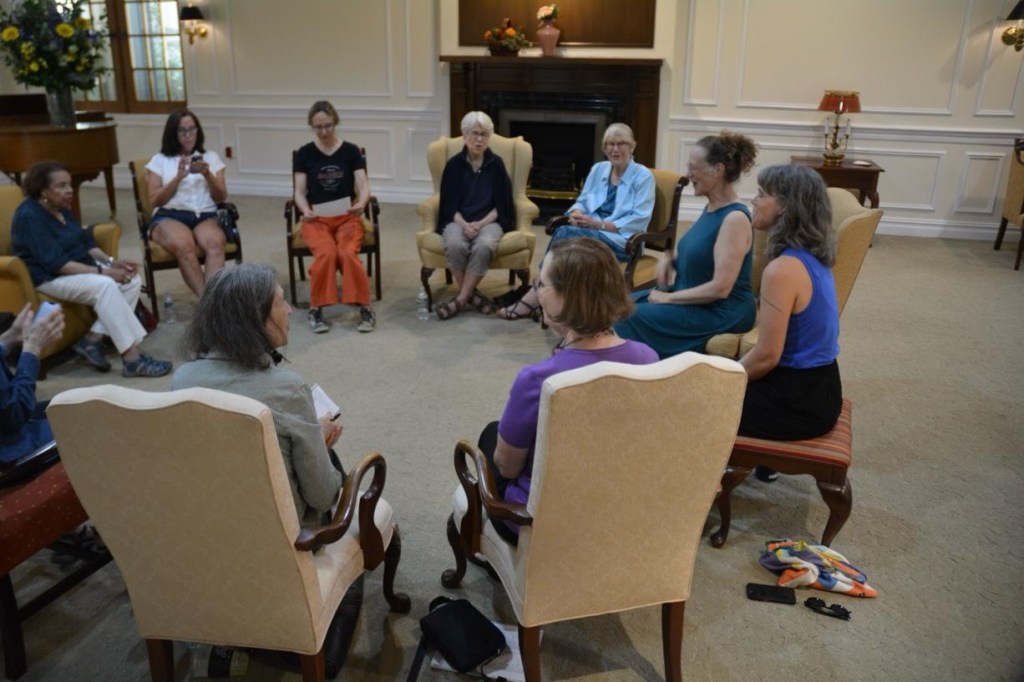
| On a temperate May evening, a dozen women settled into a circle of mustard-colored chairs. They had gathered at a nursing home to practice singing—for a very select audience.
“Before we begin, we have to nourish all our parts: body, mind and spirit,” said choir leader Dorothy Calvani.
In the center of the circle sat a cot covered with a grey blanket, as if awaiting an occupant. It stood in, one singer explained, for the dying clients choir members will sing to. Every other week, for two hours, they meet to prepare for that task.
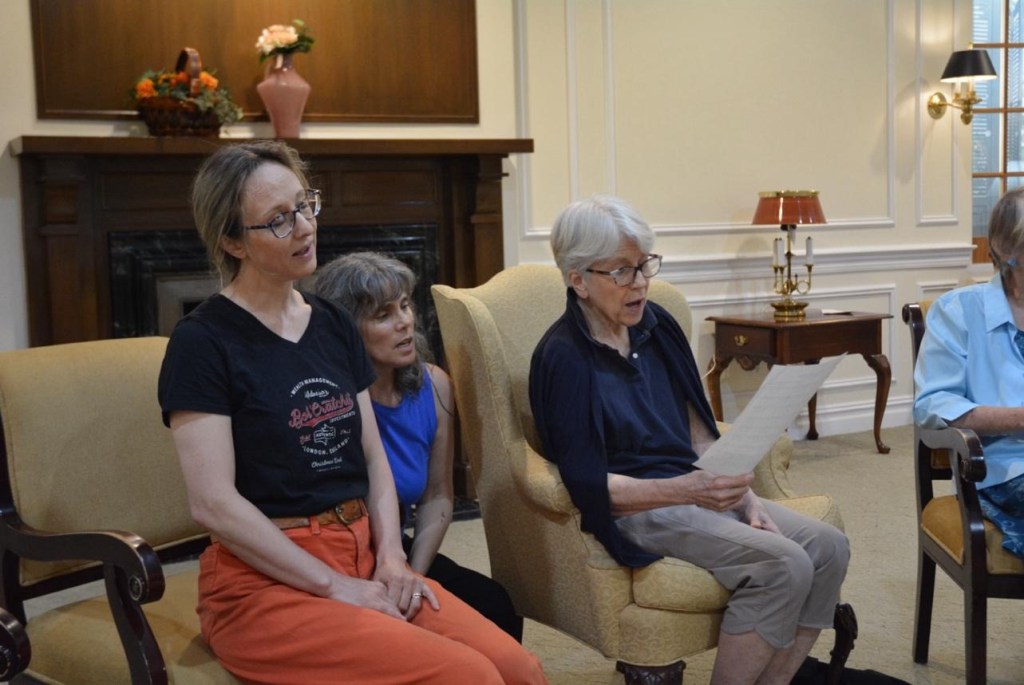
Founded in 2000, the Threshold Choir sings to clients on the border between life and death, receiving referrals from families and hospice nurses. The nonprofit organization boasts 200 chapters worldwide.
“It touches your core, your being,” managing director Rebecca Kaplan said of music’s role in end of life care. “It brings a calm, a peace.”
Kaplan, 72, had been volunteering at a nonprofit hospice when a fellow volunteer told her about the group. When Kaplan’s mother had died a year earlier, Kaplan “did a lot of singing at her bedside.” Joining the choir seemed a way to honor her.
🎧 The audio doesn’t work in the email, but you can listen on the website. Recording courtesy of the New York City Threshold Choir.
Two weeks later, four Threshold singers—Kaplan, Ruth Schroeder, Sarah Manton-Hollis, and Karen Wasserman—met in a lobby on Central Park West and ascended to see Helen, the 101-year-old client whom choir members had visited twice monthly for over two years.
The most challenging part of membership is not knowing when a visit to a client will be the last, said Wasserman, 80. She was already planning to bake Helen a cake with 102 candles.
“When I see that Helen’s on the schedule, I fight tooth and nail to get to sing for her,” Wasserman said. “She absorbs the music like a sponge absorbs water.”
The door to Helen’s apartment stood ajar; Kaplan gently pushed. An aide in floral scrubs ushered them inside.
Helen wore a velvet bonnet. As the singers entered, she broke into a toothless grin. Plastic tubes stemmed from her nostrils, connecting to an oxygen tank. A teal blanket covered her emaciated body.
On a table behind Helen’s bed lay a jumbo tub of Vaseline, stacks of blue diapers, anti-chafing cream, mouthwash, Febreze.
Helen motioned to Kaplan, then whispered into her ear. Kaplan smiled, nodded and began the first song solo of a Threshold original.
I send my love into the desert
she sang, making eyes with the others to indicate they join.
I send my joy over the mountain
they sang in unison. On
I send my joy into the sea,
Manton-Hollis introduced a soprano harmony.
Helen opened her mouth periodically yet noiselessly. Her right eye seemed stitched shut, though her left stayed fixed on Kaplan.
“Please sing!” Helen whimpered.
“Oh, we will,” Kaplan said.
They began the second tune:
So many angels gathered around...
* * *
Because music engages the emotional centers of the brain, it can make a powerful impression at the end of life, a period often marked by physical and emotional distress. Its impact, experts say, is both physiological and psychological.
“Music dives into the middle of the temporal lobe,” said David Silbersweig, a Harvard neuropsychiatrist who has studied music’s neurobiological effects. “It’s associated with areas like the hippocampus, with memory and accessing memories, and involves areas in the limbic system deep in the brain.”
In cases of severe cognitive impairments at the end of life, music therapy can help family members communicate through song. In a 2022 hospice study of a program called “Playlist for Life,” patients, relatives and certified music therapists chose music together and listened during visits. Families described the experience as a way to connect without speech.
A 2019 study examined the effectiveness of music therapy for terminally ill patients, finding that it consistently improved pain levels and quality of life, lightening anxiety and depression.
Even patients with late-stage illness or limited consciousness can respond meaningfully to music, sometimes with physiological changes like reduced levels of the stress hormone cortisol or calmer autonomic responses. In a 2018 co-authored paper, Silbersweig discussed music’s ability to evoke emotional memory, which could explain why certain songs can bring end-of-life patients clarity or peace.
A 2022 study of elderly men with mild Alzheimer’s disease showed that consistent music therapy significantly reduced cortisol. It might also increase oxytocin, the hormone associated with social bonding, Silbersweig said.
Listening to music can also influence patient perceptions of their pain by triggering an endorphin release, research indicates. Dr. Salim Namour gained renown in the 2019 Oscar-nominated documentary “The Cave” for playing classical music off his phone during wartime medical procedures. “We don’t have anesthesia, but we have music,” he said.
* * *
Helen whispered to Kaplan once more. Kaplan turned to the rain-streaked window. “How’s the weather?” Kaplan repeated Helen’s question aloud. “Well, Helen, it’s rainy today.”
Without missing a beat, the singers began, “Raindrops on roses and whiskers on kittens…”
Helen’s right eyelid fluttered open, revealing a milky iris. “Thank you!” she softly cried. “I always enjoy this.”
Kaplan placed her face just inches from Helen’s. “I’ll tell you a secret: we enjoy it, too.”
“I love you,” Helen said.
“We love you too,” Kaplan said. “We’ll be back, you know.”
“I hope so!” Helen mouthed.
Before leaving, each member grasped Helen’s trembling hand, then said goodbye.
Kaplan left last, sniffling, with red eyes and crumpled tissues. “It’s just really hard to see her failing,” she said.
Helen had never told them “I love you” before, the singers noted.
Three weeks later, choir members received an email. “With a sad heart I am writing that Helen died yesterday,” Kaplan wrote. Helen’s niece had shared the news. “She thanks all of you for bringing such joy and song,” Kaplan relayed.
At rehearsal that Saturday, members traded stories.
“I just got this feeling, when singing to her, that she was all spirit,” said Paula Winner.
“It was clear that she wanted to rest,” Manton-Hollis added.
Ruth Schroeder had the last word.
“It was something so powerful—what was behind those eyes. It always felt like a holiness.”
The group closed with “I Will Not Leave You Comfortless,” one of Helen’s favorite songs, some shedding tears. Then they bade one another farewell, dispersing into the afternoon. In two weeks, they’d see each other again.
Bella Bromberg is a freelance writer and storytelling instructor based in New York City. She holds a bachelor’s degree in English literature from Barnard College and is currently earning her master’s from Columbia Journalism School.

 Aging in America News
Leave a comment