| Q & A with the Milken Institute’s Lauren Dunning
| In this Positive Aging Community interview, Steve Gurney speaks to Lauren Dunning, director at the Milken Institute’s Future of Aging about the report The Future of Connected Care: Enabling Healthy Longevity and Aging at Home. This text has been edited for clarity and brevity.
Tell me about this report and some of the conclusions that you and your team found in doing your research.
Most of us will age at home. We know that 97.5% of older adults over 65 live either in their own home or in that of someone else, meaning, not in an institutional or congregate setting. And most people say that aging at home is their preference, even as needs change.
What’s the urgency here?
I think everybody on your podcast knows intuitively that we are experiencing demographic change. We’re going from 63 to 82 million older adults by 2050 in the U.S., but that’s not the entire story, because with this demographic shift, we’re facing shortages of direct care workers who provide home care and health care to older adults. Family caregivers are stretched.Family sizes are smaller; many live far away and are working, and there are more solo ages than ever.

Oftentimes we introduce people to health-related technologies, and they say, ‘Oh, that’s nice, but I’m not ready for that yet.’ What do you think are some of the main barriers for people adopting some of this tech that you’re talking about, and how can we better address this?
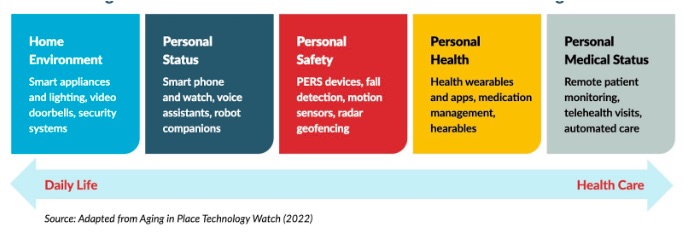
Ninety percent of older adults have smartphones. The average older adult has seven smart tech devices at home. In many categories, ownership is on par with people of different generations. And about 50% have adopted technologies that help them explicitly to age at home and help their health at home. Now, do we think that more people could benefit from adoption? Absolutely. And one of those barriers that people report is that they don’t think that technologies are being made with people their age in mind. The advent of AI lets us have actionable insight into people’s home and experience as they age about what they need, what they want, and where the opportunities lie for them personally.
Six Building Blocks for Action
- Characterize wants, needs, and use cases
- Taxonomize connected care at home to link solutions
- Generate proof-of-concept, evidence, and validation
- Develop sustainable payment models
- Build a digital front door to data and solutions
- Increase awareness, access, and adoption
Can you say more about the “digital front door”?
You go on your iPad, and you open an app, and that app shows you all the devices you’re using. It has a dashboard with the health metrics that are important to you, metrics about your life, about nutrition activity, social connection. This is the portal with the tools you might connect with, based on that data.
The thing that I like about adopting this technology earlier in the chapters of our life is that then the stigma of, ‘Oh, you’re buying me this robot because I’m old and I’m not as good as I used to be.’ No, I’ve had the robot sitting here in my office since I was in my twenties and thirties, and it helped me with brainstorming and now it’s helping me with brain exercises and monitoring my balance and what have you.
All of us are using different kinds of assistance already, and it’s only going to get more and more tailored, more and more ubiquitous, and the more we normalize it and make it about assistance across our lifetimes, the better.
What are the conclusions that we should know about with this research?
This shift is central to the trends that are happening, writ large, in our society about how and where we access care,how we’ll live when we need care. And there are action steps for different sectors that might play a role in creating the environments. You’re doing your future self a favor. You’re supporting your family. Older adults are helping meet their own goals of independence and preference, and these supports are there, and they’re only going to get more widespread as folks in our ecosystem are working hard to make that happen.
Whether you are an individual and you’re caring for a loved one, if you’re in this business space and you’re taking care of other people, if you are a policymaker or a town supervisor, the data in this report can be information that can inspire people in your community to make changes. There’s just so much good that can happen with this. And ultimately, the better we can make it, it’s going to be better for ourselves. It’s going to be better for our loved ones and future generations.
That’s what we’re all aiming for. It’s an aspiration. And the good news is we’re doing more work in this space. We have at least two more publications in a series related to this report. So more action, more ideas, more design to help us keep moving.


 Aging in America News
Leave a reply to Peter Metsopoulos Cancel reply