| But Few Can Make a Living Doing It (part 2 of 2)
| Bella Bromberg
| Holly Strelzik, 64, has silver hair, tawny skin, and for a recent video call, donned a faint splash of sparkly white eyeshadow, dangly earrings, and a white beaded necklace. Between bites of a chocolate bar, the New Jersey-based death doula explained how she came to found the Center for the Heart, a nonprofit that contracts with doulas and partners with hospices and medical organizations to provide end-of-life care to clients in need.

“It’s beautiful work,” she said of being a death doula. “It’s being able to connect at a whole different level.” Center for the Heart charges $135 an hour and employs about 20 part-time contractors vetted in New York and New Jersey. Strelzik only hires doulas who have completed an end-of-life doula training program; in particular, she favors applicants who trained at University of Vermont, International End of Life Doula Association (INELDA), or the International Doula Life Movement (IDLM), programs she deems most rigorous and comprehensive.
Dedicating years to this work has helped Strelzik reflect on how she wants to spend her own final days. “I want to be a coral reef—I want to be bathed everyday,” she said. “And every few minutes, I want some chocolate in my mouth,” she added with a smile.
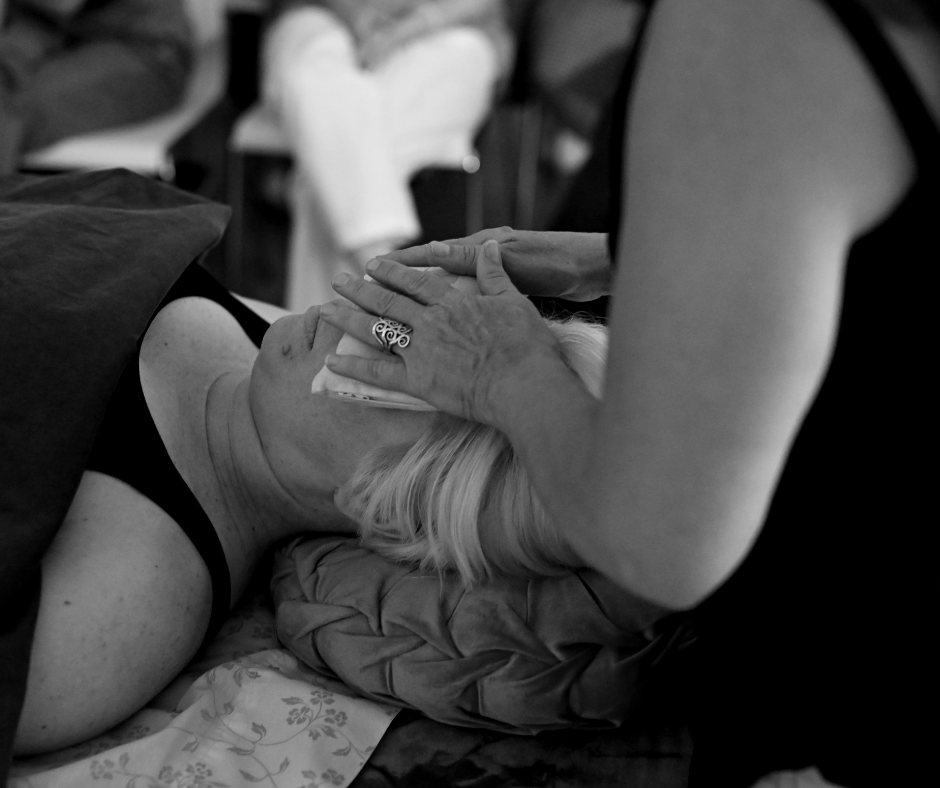
Strelzik started her career far from death work: in the world of corporate banking and public relations at companies like Coca-Cola and Citibank. The roles endowed her with a strong business acumen, which she now cites as instrumental in getting her doula enterprise off the ground. But at 44, she suffered a brain aneurysm that nearly killed her. The experience instilled in Strelzik a deep respect for the deathcare field. Shortly thereafter, she left her job and started volunteering in hospitals, where she found comfort at bedsides of the dying. She obtained her mastery in Reiki, the energy healing practice, and later completed certificates in grief education, thanatology, and, of course, end-of-life doula training. When her husband received an Alzheimer’s diagnosis in 2020, the work’s importance became personally consequential.
Strelznik’s husband, for whom she now serves as de-facto doula (coordinating legacy projects and pre-emptively organizing his deathcare affairs), enabled her to follow this path; his career earnings have helped support the family financially. “I’m blessed,” Strelznik said. “The guy with Alzheimer’s made a good living.” Not all death doulas enjoy such a cushion, however.

Ashley Johnson, 40, has served as the president of the National End-of-Life Doula Alliance for the past four years. The Alliance has about 2,000 members nationwide, and Johnson said interest in the work has increased “tremendously in recent years, as more people respond to the value of “holistic, nonmedical” end-of-life care.
Despite growing demand, Johnson affirmed most doula work remains unpaid or privately paid. “As an end-of-life doula, our work is rarely reimbursed to never reimbursed, so it’s typically paid out of pocket,” she said, a structure that “limits services for families who cannot pay for it. The lack of insurance reimbursement, she added, creates “economic precarity for those that are committed to this type of care, often requiring secondary income and increasing the risk of burnout due to the emotionally taxing nature of the work.”

According to Johnson, policymakers need to understand that nonclinical care matters immensely during a dying person’s final days. “End-of-life care is not just about medicine. It’s about presence, it’s about dignity, it’s about guidance,” Johnson said. “Our work is a labor of love. It’s a labor of care.”
Without insurance covering doula work, aspiring death doula Jill McClennen, 47, doubts the career path will ever be financially viable. McClennen recalled a conversation in which a friend advised her to host a Death Doula certification course to bring in some income. The proposition struck a disquieting chord in McClennen.
“That, to me, felt like a bit of a Ponzi scheme,” she said. “I’m asking people to pay me to train them in a career that I’m not even making money at.”
For Kelly Butler, 57, who leads workshops on grief and end-of-life preparations for over 300 students each year, it’s key to be transparent with aspiring doulas about the financial challenges of the work.
“I am absolutely upfront, because I think I encounter people who might have been misled, like ‘Company X is hiring doulas and it’s full time work’—and that doesn’t really exist,” Butler said. “People doing this work are working independently, building a practice, building a network. If you’re looking for health benefits and a 401(k), that does not really exist in the realm of being a doula.”
Butler, who has been involved in death doula work for more than three decades, ultimately hopes to see deathwork return to its ancient roots as community-based activity everyone takes part in—and finds the move towards professionalization distressing. Though Butler understands many of her students seek to pursue the work as a career, she sees her role as instructing people, not professionals.

Those who seek Butler’s teachings usually want to take on death doula work part-time or add the skill to their existing practice as a psychotherapist, social worker, or nurse. But at least half of her participants simply want to learn how to be able to care for their family—and themselves—“when their own dying time comes,” Butler said. “People really understand it to be a life skill that they are developing and I think that that’s probably because I make it pretty clear,” she said.
Butler, who is based in Ottawa, ON, fears a future in which the work of caring for the dying—which she considers the innate responsibility of all humans—becomes inaccessible due to inordinate regulation.
She understands why many doulas are pushing for professionalization. “If this was a regulated practice with a certified body, it would mean that death doulas would be covered by insurance,” Butler said. “But this is not work that should pass certification or exam, because it’s the work of being present, of being human.”

Moreover, “the bigger reason is that marginalized communities never stopped doing this work,” Butler said, citing Muslim, Jewish, indigenous and remote communities as examples of groups who have always cared for their dying and their dead. For Butler, taking care of the dead should be a natural role humans and communities take on: an opportunity to serve rather than a job.
“If we turn it into something that has to require an exam, we are going to penalize the very people who never forgot the practice, and then make something that they’ve always done inaccessible to them,” she said.
Johnson, the President of the National End of Life Doula Alliance, feels confident that even if nothing changes with funding and policy structures, the field will persist. “It will survive,” she said. “Because as long as we’ve been living, we’ve been dying.”
Bella Bromberg is a freelance writer based in New York City. She holds a bachelor’s degree in English from Barnard College and is earning her master’s from Columbia Journalism School. She works at The Moth, the storytelling nonprofit.
Support for this reporting came from the Better Life Lab at New America.
Leave a Reply