
| Nikhil Patel
| “Every older person in your community has a story worth telling.” In the spirit of this declaration, Aging in America News and The Legacy Project collaborated to field and publish five intergenerational portraits composed by younger (17-25 years old) writers. Patel’s is the second in the series.
| The retirement party was louder than I expected. In my experiences, hospitals tend to hum, monitors beeping, carts rolling, doors swinging open and shut, but that morning, Duke Regional roared with life. There was laughter echoing down the hallway, paper plates clinking against folding tables, someone attempting a toast that kept getting interrupted by cheers. Between bursts of applause and the low murmur of coworkers swapping stories, the unit felt briefly suspended from its usual rhythm. Margaret “Margie” Muir stood near the center of it all, smiling as people hugged her, thanked her, and tried not to cry (the piles of tissues in her hands said otherwise). After 42 years at Duke Health, this was her final week in a building she had quietly shaped in ways most patients would never fully see.
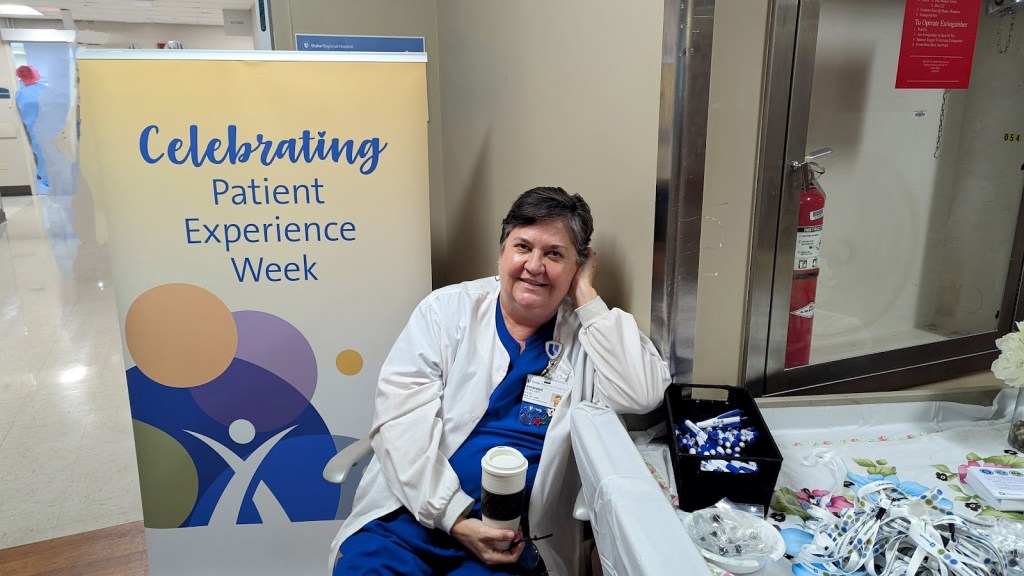
Margie didn’t command the room so much as she held it. She laughed easily, brushed off praise, and redirected attention back to others, asking about families, reminding people to take leftover cake and fruit home, slipping into conversations that felt less like goodbyes and more like continuations. Watching her that morning, I could see that her work had never been about recognition. It had been about being a silent presence.
I met Margie nearly a year earlier, at the beginning of the summer, through volunteering at Duke Regional Hospital. On my first day, before I had fully learned the layout or memorized badge-access doors, she made it a point to walk with me through the hospital, not just the units I would work on, but everywhere. She introduced me to nurses, administrators, patient advocates, and, just as importantly, to members of the janitorial and environmental services staff. She explained what each person did, why their role mattered, and how hospitals only function when everyone is seen.
It was not a scripted orientation. It felt more like an invitation into how she understood healthcare and how to honestly care for patients.
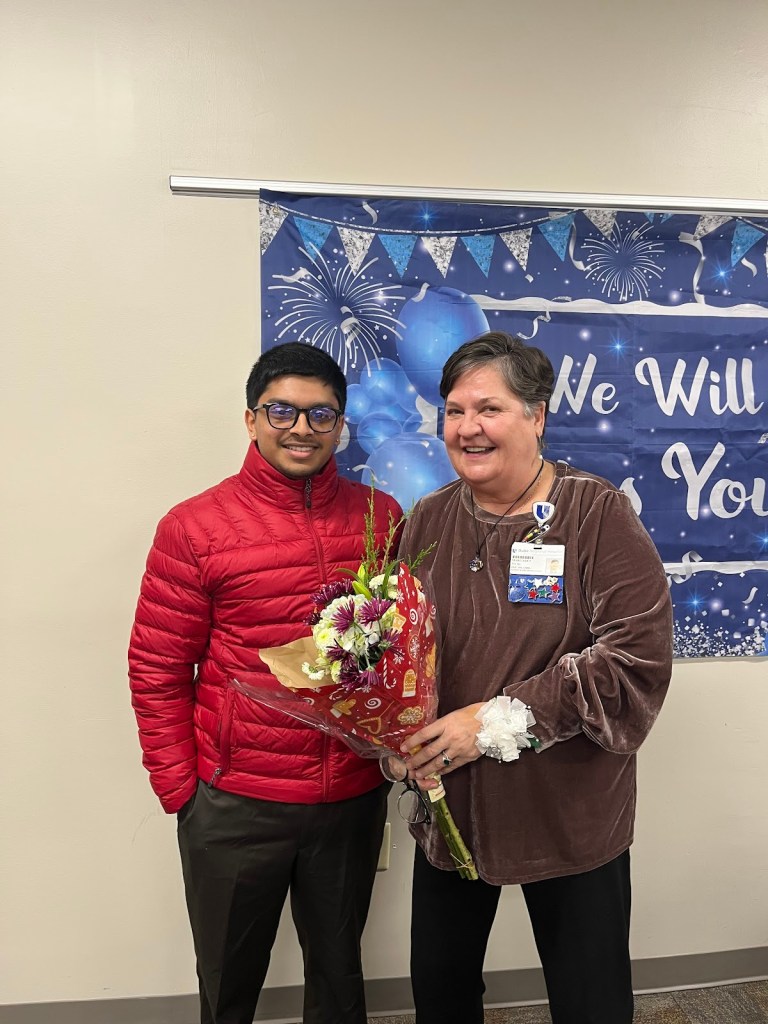
Margie began her career at Duke University Hospital in 1984. Over four decades, she moved through roles spanning bedside care and leadership—staff nurse, clinical nurse specialist in pain management, nurse educator, director of Women’s Services, and, ultimately, a leader of Duke Regional’s Patient Experience journey. But what stood out to me was not the breadth of her titles; it was how little distance she placed between herself and the people those titles served.
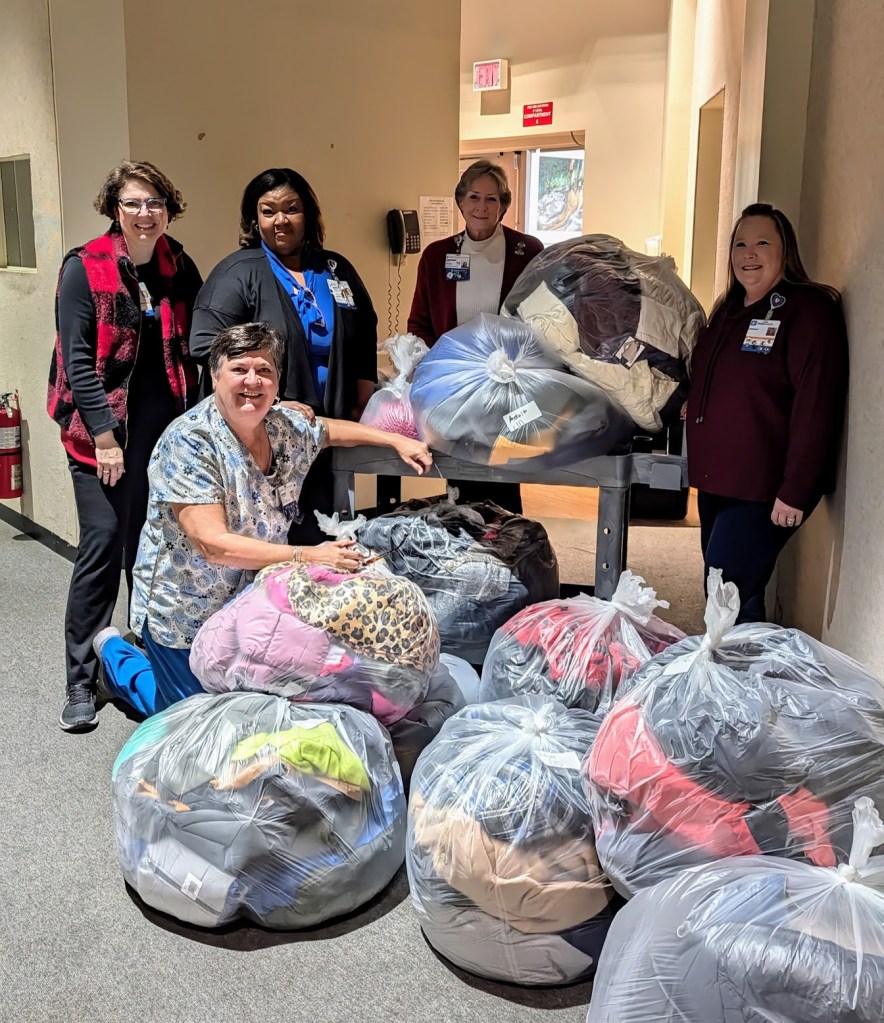
Patient experience, as Margie practiced it, was never abstract. It was tangible. It showed up in the Caring Closet she founded, which began modestly and grew into a program that now provides essential support to patients and families—clothing, toiletries, small necessities that restore dignity in moments when life feels stripped bare. It showed up when she noticed a Mamava pod in an airport and imagined what privacy and respect could look like for breastfeeding mothers in a hospital setting. Because of her persistence, seven pods now exist across the Duke Health system.
Her compassion extended beyond patients to her colleagues. She coordinated 38 Red Cross blood drives, donated twelve gallons of her own blood, and served as a bone marrow donor. She championed education and inclusion, earning a Diversity, Equity, and Inclusion Award for teaching transgender care to hundreds across the hospital, community, and local nursing schools. She mentored nurses across the state and nationally, helping build confidence and leadership in those who would outlast her tenure.
Yet for all of these initiatives, Margie never framed her work as extraordinary. She treated it as necessary.
Over the course of the summer I met her, I began to notice something small and easily overlooked: a quiet corner of the hospital where people often waited, families, killing time between updates, staff pausing between shifts, patients sitting with little to distract them but their thoughts. At first, the space was mostly empty. A chair. A wall. Nothing to anchor the moment.
Margie noticed it too.
Thinking back, we first connected over a shared love of literature, especially Russian novels. We traded favorites like Dostoevsky and Tolstoy, debating whether Crime and Punishment or Anna Karenina was better. She talked about books the way she spoke of people, with a gentle care and specificity. Reading, she believed, could soften the edges of anxiety. It could offer escape, companionship, or simply a way to pass time when time felt heavy. Slowly, almost without announcement, that empty corner began to change. A few donated books appeared. Then more. Then a shelf. We helped organize it. Margie decorated it thoughtfully, changing touches with the seasons, making it feel intentional rather than improvised.
By the end of the summer, the corner had become a small library. It wasn’t labeled as a program or tracked by metrics. There were no forms to fill out, no outcomes to measure. People simply took a book when they needed one and left it behind when they were done. It belonged to everyone and no one at once.
That, I realized, was Margie’s gift. She understood that care doesn’t always announce itself. Sometimes it waits quietly, trusting someone will find it at the right moment. As Margie prepared to retire, colleagues reflected on her leadership, humor, warmth, and willingness to stand up for her team. She had implemented Patient Experience Week at Duke Regional for 10 years, presented nationally at the Press Ganey Conference, and received the 2025 Michigan State Distinguished Alumni Award. She had helped build career ladders, mentored future nurse leaders, and shaped a culture that valued kindness as much as competence.
But when I think about Margie now, I think about that bookshelf.
I think about how her career began in service and ended the same way, not with something she took with her, but with something she left behind. In a hospital defined by movement and transition, she created a place meant for pause. A place where stories could be picked up, set down, and carried forward.
Margie once told me that healthcare is ultimately about how people feel when they are most vulnerable. Her legacy lives in countless programs, policies, and people, but it also lives in that quiet corner, where a book waits patiently for the next person who needs it.
And in that way, even in retirement, Margie is still caring for people she may never meet.
Nikhil Patel is an undergraduate student at Vanderbilt University interested in public health, health equity, and the human stories that shape healthcare.
 Aging in America News
Leave a comment