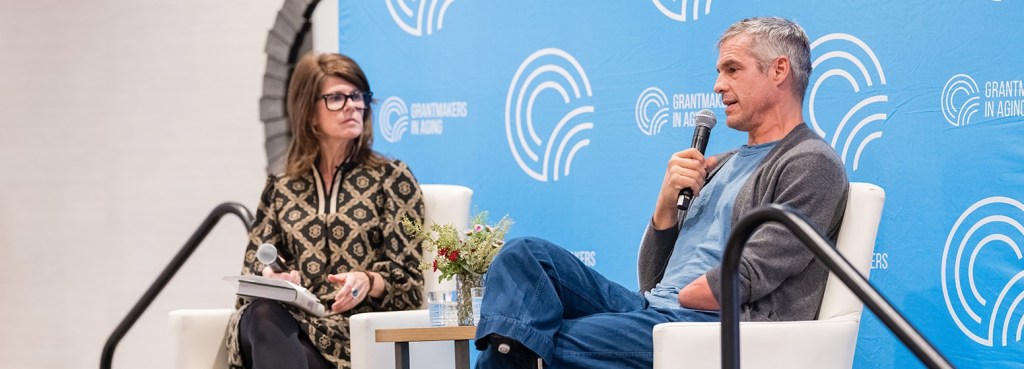
| Rachael Watman interviews Dr. BJ Miller
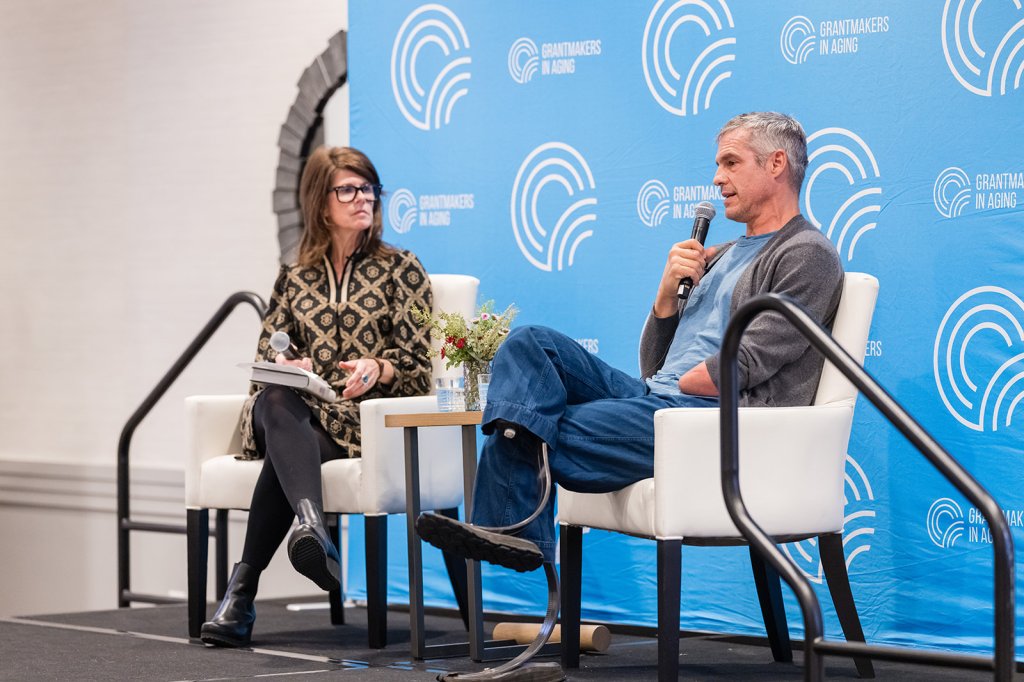
| How do we live well in the face of serious illness and end of life? In this interview, renowned palliative care physician Dr. BJ Miller (co-Founder, Mettle Health; author, A Beginner’s Guide to the End) explores why these experiences are not separate from aging, but vital to it. At the 2025 Grantmakers in Aging conference, Dr. Miller sat down with Rachael Watman, vice president of programs at the Rita and Alex Hillman Foundation, to share insights on transforming care for people with serious illness, their families, and caregivers. This interview has been edited for length.
In a 1975 interview for People Magazine, a 31-year-old Mick Jagger famously said that he’d rather be dead than singing “Satisfaction” at 45. And now we have an 82-year-old Mick Jagger who continues to sing “Satisfaction” at Stones concerts as the final encore. So at the risk of triggering your inner Mick Jagger, can you tell us more about you
I’m an amputee and have been for 35 years. When I was 19, I had electrical injuries and came close to death. I realized I was mortal, not just the idea of it, but in my bones. And you get that into your bones early and that’s when you can really start living. Fear changed for me. I got to see how people can care for each other. The big thing about mortality is our interdependence, how we need each other. The fact that we as a species know we’re going to die and have to find a way to love life even while losing it is really mind-bending. I was very interested in having a pulse, but I was really interested in feeling alive and that became a very different mark. That’s what took me into palliative care.
Death is thought of as the worst thing we can imagine, as the enemy, as punishment, as a failure. Why is this the case? Can openly talking about death contribute to better care?
I think we lumber under the assumption that death is the worst thing. The language is terrible, as though dying is a personal failure. Like you didn’t eat enough broccoli or something. You didn’t try hard enough. We really project a lot of junk onto each other around the end of life because we don’t talk about it. All that language could not be more wrong from where I sit. There’s not ‘life versus death.’ Those are not opposites. Once you get it in your nervous system, it can really unlock a lot for you.
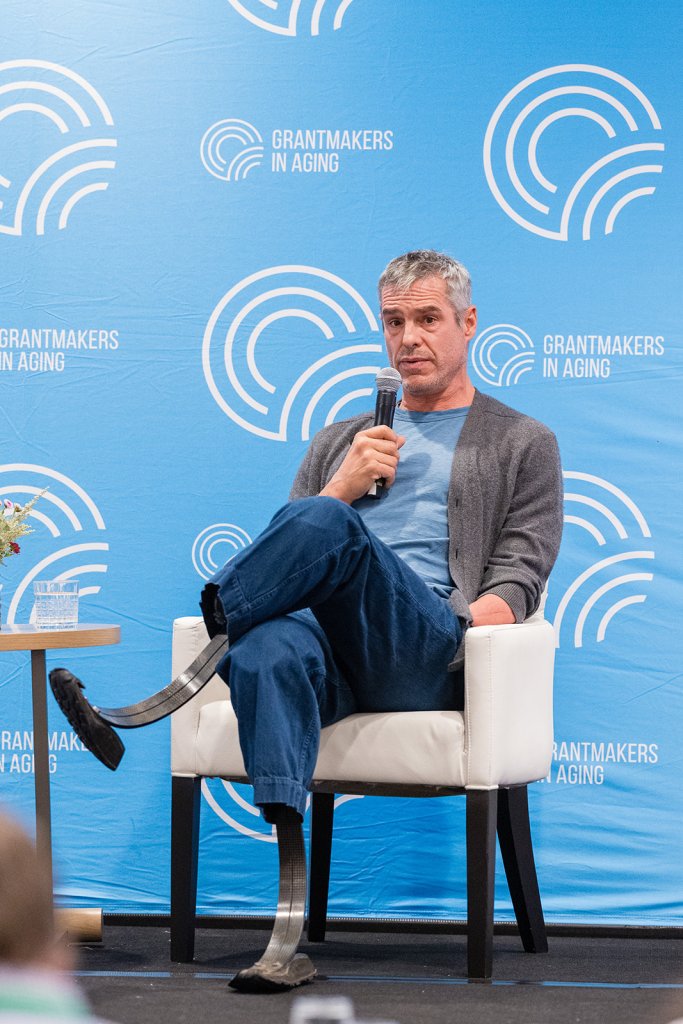
You’ve been interviewed by some of the giants in the industry. You’ve been interviewed by Oprah, by Anderson Cooper, by Gwyneth Paltrow. You have been in two episodes of Chris Hemsworth’s National Geographic, The Limitless Series. You’ve spoken with some really well-respected people and big audiences about serious illness and dying. What do you wish that someone had asked you?
There’s probably a long list, but what comes to mind relates to my professional life. Comfort is often the goal in hospice and palliative care. But as a life goal, it’s kind of hollow. I moved on to meaning—how we make or find meaning in our lives. But then you bump into things like cognitive decline and you start realizing that narratives of meaning need words, language, time, cognitive power. That’s where I hear folks who say, “Just take me out back the second I don’t recognize you.” Just because we can’t imagine how we’ll feel someday doesn’t mean we won’t deal with it well. How many times have you been hurled into a situation that if in advance would’ve been terrifying, but then you’re in it and you just find a way. There’s something beyond our cognitive abilities to weave stories. There’s this aesthetic realm, this place of just feeling something. Even pain can tell you you’re alive. I’m happy to have a body because it feels things. It’s a sack of sensors.
Racing legend Mario Andretti once said that if everything seems under control, you’re not going fast enough. Can you share about letting go?
When I was in the burn unit, I was completely dependent. Would I have ever chosen to be dependent? No, but I was, which helped me realize the truth of our mutual dependencies. I got to see what comes on the far side of control and how much poignancy and beauty came from things I never would’ve chosen. The world of wellness focuses on what you can control. But we don’t develop a relationship to all that we can’t control, which is the vast majority of life. If you really want to prepare for end of life, that has to do with having some relationship to what you can’t control. Can we learn to love reality? Reality includes death. Don’t pretend you don’t have any control, but please don’t pretend you have total control either.
If you could change one misconception or fear about dying, what would it be?
That suffering is not required. I’d also like to reposition all our language of failure and of decline. Not only does it not have to hurt, but can we be interested in what’s possible? Can we see a crescendo? In what ways can we ascend into death, versus just withering? Our bodies might decline by some physiologic measure, but your spirit doesn’t necessarily. Your emotional life, your wisdom, your maturity, your ability to see beyond yourself—all those things can be on real ascent at the end of life.
Where do you see the biggest disconnect between what people need and what the healthcare system currently provides?
The medical system tried to separate social issues from medical issues. It’s not an accurate depiction of being a human being. Another would be acute versus chronic care. We know probably 80% of us will die from chronic conditions now. The old days of being fully alive until a moment and you’re dead—that just doesn’t happen very much. I think one of the reasons why chronic care and care for folks who have functional limitations and disabilities is so ironically relatively poor is because it seems to connote if you need chronic care, that means you’re not curable. And we really like people to be fixed. And when it’s possible, great, but everything else gets orphaned and that’s the big problem.
Any final thoughts?
Everything that’s ever lived will die. It’s this thing we have in common with each other and with anything that’s ever lived. It’s telling that end of life ends up being isolating in the worlds we’ve constructed, but in the natural world, it is what you have in common with everything. If your work is pushing back on suffering, if you’re trying to amplify beauty and connection, if you’re interested in caregiving—you’re already part of the team supporting hospice and palliative medicine. Just talking about this subject really helps defang it for people and normalize it, make it less scary.
 Aging in America News
Leave a comment