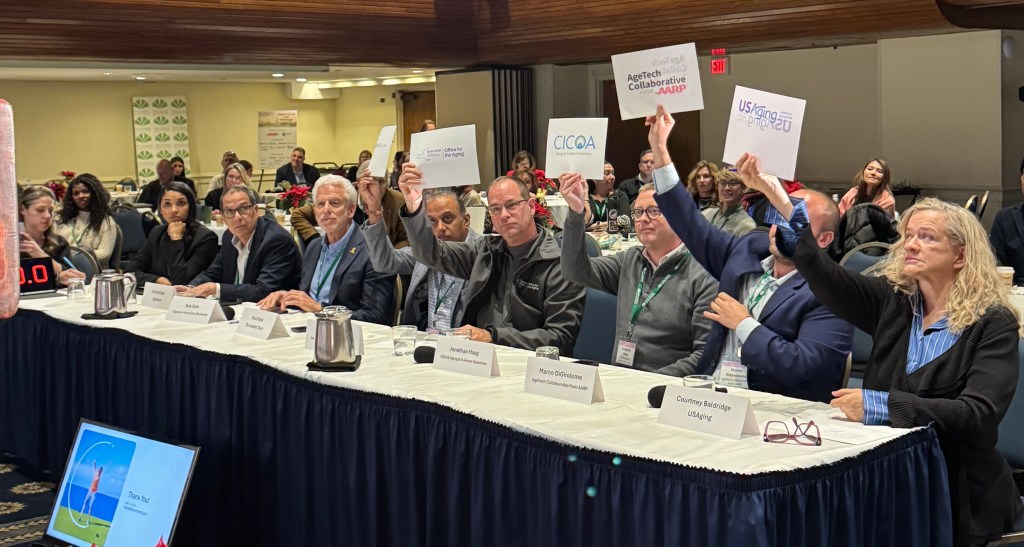
| Our Takeaways from the 2025 What’s Next Longevity Innovation Summit
| Jane Nam (AgeTech Journal) and Mark Swartz
| Researchers, funders, entrepreneurs and policymakers gathered in mid-December at the National Press Club for the What’s Next Longevity Innovation Summit. Notable speakers at this year’s event included Mehmet Oz (Administrator for the Centers for Medicare & Medicaid Services) and representatives from AARP, TIME, and CNN.
When we pooled our notes, we discovered a number of worrisome trends in the national picture. “These pain points,” maintained Jason Resendez of the National Alliance for Caregiving, “are policy choices that we make as a society.” (Read more.)
While Nancy LeaMond, chief advocacy and engagement officer for AARP, contended, “The home is the new care setting,” Mary Lazare, principal deputy administrator, Administration for Community Living, acknowledged, “Our system of institutional care cannot accommodate all the people who want to age at home.”
Mary Furlong, producer of the event, reminded us that there is a flipside of these trends, saying, “Every dissonance of aging is a market opportunity,” while Anna Banks, AARP’s chief marketing officer, added: “This is the largest addressable market in human history.”
By the Numbers
63 million
Number of Americans who provided ongoing care for an adult or a child with a complex medical condition or a disability in the past year, according to a new report by AARP and the National Alliance for Caregiving
60%
Percent of family caregivers who are managing complex medical tasks, such as feeding tubes
20%
Percent who have received medical training
33%
Percent of caregivers who have been providing care for 5 years or longer
50%
Percent of caregivers who report being negatively impacted by caregiving, including negative financial impacts (such as taking on debt and using high-interest credit cards)
60%
Percent of caregivers who are in the workforce full-time or part-time
$5,000
Amount of a family caregiver tax credit championed by AARP
5 million+
Number of older adults and people with disabilities nationwide who rely on health and supportive services through Medicaid’s Home- and Community-Based Services program, according to the SCAN Foundation. Cuts to the program mean avoidable hospitalizations will rise, contended SCAN’s Sarita Mohanty.
77%
Percentage of older adults want to age at home. Discover Samsung Health House, a collaborative showcase featuring 10 startup companies
90%
Percentage of older adults who own smartphones, according to AARP
$600 billion
Size of the unpaid caregiver market
40%
Amount the 50+ population pays of state and local taxes in New York State
50%
Older adults who are malnourished or at risk of being malnourished
Dig Deeper
Discover the SCAN Foundation’s The People Say, a qualitative data platform featuring older adults talking about their lives and the policy issues that affect them.
Maryland’s Longevity Plan: How One State Could Help Redefine Aging in America
Raising Tech podcast episode 98: Mary Furlong on the Future of Aging and Innovation in Senior Living
Mary Furlong’s Convening Power
 Aging in America News
Leave a comment