| Filipino Caregiver Stories
| Frances Angela Rodriguez
| Aging in America News is partnering with Tayo—whose mission is “to empower the Filipino community by providing accurate, culturally relevant information and essential services”—to explore cultural ideals about caregiving.
| What comes to mind when you hear the word “caregiving”? In the United States, caregiving is often viewed as a professional service shaped by systemic and logistical barriers, especially rising costs. It’s usually framed as a role rather than a cultural heritage. In contrast, Filipino caregiving is cultural and communal. In our culture, several values capture the caregiving experience:
bayanihan (community support)
cyclical caregiving
relational care
mano po (respect for elders)
kapwa (mutual respect)
These values guide how care flows across generations, from grandparents and aunts who raised us, to us now supporting them. It is caregiving rooted in love, shared responsibility, and family, not obligation or transaction.
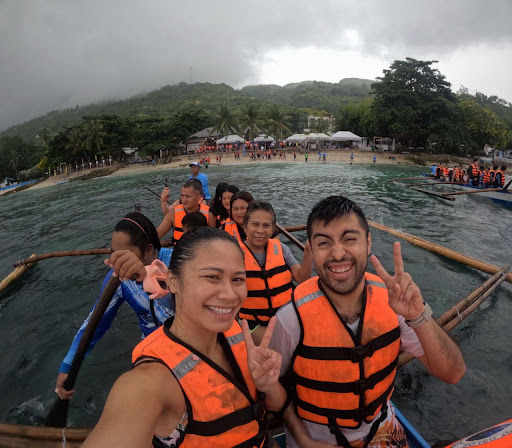
Throughout my childhood, I had a village that supported my family, whether we were living in the Philippines, Japan, or the United States. My aunt was an important part of that village in the Philippines. She helped my parents raise my younger brother and me and continued supporting us from afar when she moved to Hong Kong for work, and later when we moved to Japan and the United States From a young age, I remember how present she always was, so much so that I had a nickname for her, “Mama Abeth,” because she acted like a second mom to my brother and me.
One of my fondest memories with her and my uncle was spending Christmas at their home in Cincinnati when I was around ten years old. After a 20-hour drive from South Dakota, we were welcomed with love, laughter, joy, and delicious Filipino food. As time goes on, we may forget the small details of our family memories, but we never forget how they made us feel.
Last year, my aunt was diagnosed with stage 3 cancer. She had to undergo immediate surgery followed by chemotherapy. The challenge was that I was in Houston, my parents were in Seattle, and she was in Cincinnati.
Our first instinct was not if we could support her, but how.
While she had relatives in Ohio, having her full village with her felt essential during one of the hardest seasons of her life. My mom, our relatives from Dallas and Los Angeles, and I decided to travel to Cincinnati to be there for her.
After landing in Cincinnati, I was picked up by one of my relatives and taken straight to the hospital. Carrying my backpack and small carry-on, I followed my uncle and mom’s directions to my aunt’s pre-op room. When I walked in, my heart felt full, seeing several family members and relatives gathered around her. Throughout the morning, doctors and nurses came in to explain details about the surgical procedure. Although my aunt is fluent in English, she appreciated that I could translate everything into a mix of Tagalog and Bisaya. Hearing medical information in our native languages not only made it more accessible but also made the experience feel more personal, relatable, and human.
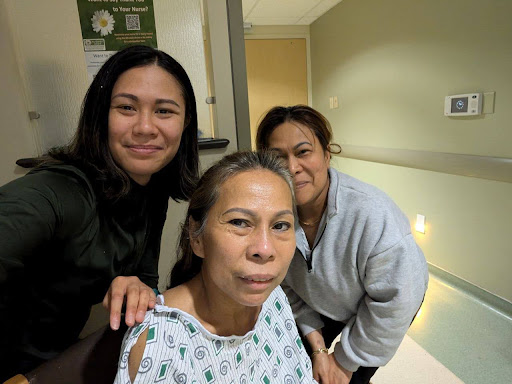
One of the most raw moments of the journey was seeing my aunt rolled into her post-op room. She was at her most vulnerable, yet visibly relieved to be surrounded by family, relatives, and friends. For the next few days, my mom and I stayed in the hospital room with her so we could help around the clock. We assisted with feeding, adjusting her bed for comfort, calling the nurse when she felt pain, helping her walk the hallways to regain mobility, and offering emotional support. My uncle, our relatives, and her local friends supported other caregiving tasks, including bringing food from her favorite restaurants and bringing her essentials from home. My aunt told us that the most important part of caregiving wasn’t any specific task, it was simply our presence.
My caregiving journey with my aunt brought Filipino cultural values to life.
Observing caregiving in the Filipino culture and being a caregiver to my aunt deepened my appreciation for my family, my culture, and my sense of identity. In many ways, caregiving in the Filipino culture is not just something we do, it is a heritage passed lovingly from one generation to the next.
Frances Angela Rodriguez is a health policy and public health professional based in Houston, TX. Fluent in Tagalog and Bisaya, she is a proud first-generation Filipina-American who draws on her lived experiences to advance community-driven public health and health policy solutions. She is a policy and advocacy coordinator for Tayo.
 Aging in America News
Leave a comment