| Q&A with Next50’s Peter Kaldes
| Next50 is a private foundation based in Denver, Co., and devoted to “creating a world that values aging.” Aging in America News spoke to President and CEO Peter Kaldes.
| How did you get into this work?
| Over the course of my career, whether it was working in the Obama White House as an economic policy advisor, practicing international law, leading nonprofits like the American Society on Aging, I’ve always been drawn to changing the future of our society. Law, policy, business, and economic development are all levers for change. And now that I look back on it, my real connection to aging occurred because of my grandparents. They lived long meaningful lives. As a Greek immigrant family, we lived in a multi-generational household. When I joined Next50, I was reminded of how few private foundations there are that actually focus on aging.
Why do you think that is?
I think what ends up happening is, people think other foundations will handle it in the context of family or in the context of work. And yet you see repeatedly how aging gets left out. Health care isn’t enough. That’s not the only crisis that we’re facing as we age. It’s the economic side of aging, the affordability of housing, the workforce part, caregiving, transportation, and, of course, ageism. Aging is a megatrend. So I think it’s the defining economic opportunity of our time.
What are the special challenges and opportunities in Colorado’s aging landscape?
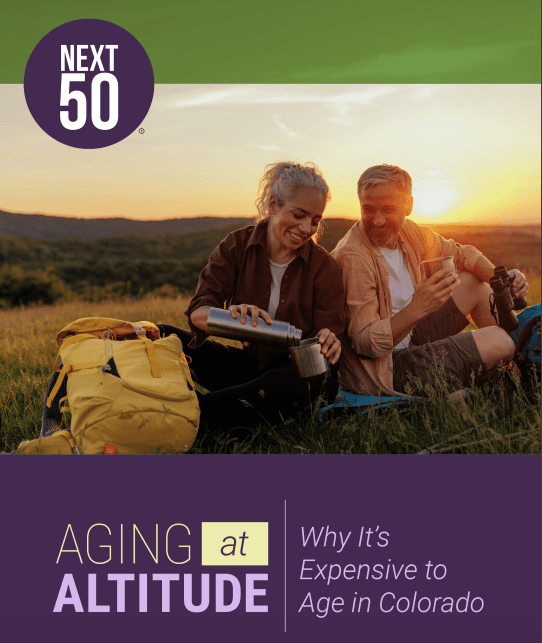
We just issued a report called Aging at Altitude, which highlights these economic issues. The state is kind of a pressure test really for America’s future. We’re already at a point where there are more people over 60 than under 18 in the state, and about a third of these people live at or below the poverty line. The challenges are related to affordability, to long-term care. They can’t find jobs, they have little digital access, particularly if they live in rural areas, which most of the state is. But the opportunity is huge. Colorado is proud of its entrepreneurial spirit. It’s data-driven, a lot of science and strong academic institutions here, but it’s also diverse socially and geographically between rural and urban. And I think they are all willing to take some bold experiments.
Which of your grantees are doing the boldest work?
One example would be Homeward Alliance, which offers housing based case management. Brothers Redevelopment provides affordable housing for older adults. A Little Help works with volunteers to empower older adults to thrive in their homes and where they are. There’s a lot of opportunity in Colorado that can be exported to other states.
Does Next50 look at what’s going on in other countries and try to import solutions and cultural ideas?
We’d be foolish not to. The U.S. doesn’t have a monopoly on good ideas when it comes to aging. Japan, for example, has been the canary in the coal mine, if you will, when it comes to global aging. They’ve been really thoughtful about how to build entire cities like Yokohama around universal design. There’s a strong emphasis, for example, on public safety, and the idea of creating livable environments where people, regardless of age, can feel secure and safe and go about their business. Denmark has invested in multigenerational housing. Singapore has some really interesting laws on the books that promote older workers, and they see them as a contributor to the economy, not a drain on it. We recently partnered with HelpAge USA to import the Friendship Bench program from Zimbabwe. It’s a physical meeting place where volunteers come together to meet with older adults. America should stop treating aging as decline and start treating it as design. At Next50, we’re inspired by these lessons on how other countries value aging.
How is Next50 addressing ageism?
Culture changes when stories change. That’s why Next50 invests in media and narrative strategies that value aging—in other words make aging real, visible, vibrant, and aspirational. Ageist beliefs start as young as 3 years old which is why, actually, we start young. We partnered with WETA (the PBS station in Washington, D.C.) and Fred Rogers Productions to include diverse stories of older adults and their caregivers in popular children’s programming like Daniel Tiger. We’ve also funded anti-ageism guides in New York City public school systems, where teachers review their curriculum and intentionally remove ageist takes on history or English or other subjects. We also support the Geena Davis Institute, which looks at the portrayals of older women in media. We’re just trying to normalize that you can have a 75-year-old accountant or a 65-year-old launching a startup.
A big difference between Next50 and most other foundations is the way you invest your endowment? Can you explain how that works?
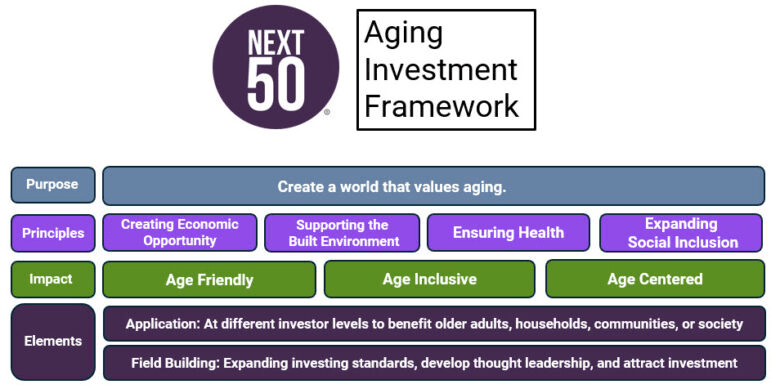
The IRS requires private foundations to give out at least 5% of their corpus annually or face steep taxes and penalties. When I came on board, I asked, ‘Okay, what about the other 95%? What are we invested in there?’ Last summer, we embarked on a journey of making sure that every dollar basically works twice, One for capital and one for impact. We created something called the Aging Investment Framework, which comprises four key areas. We think if we invest in them we can help have some impact and actually attract other capital to shift how we support aging around the world.
How do you operationalize that?
We’ve partnered with JPMorganChase to really look at every single thing our endowment is invested in and make sure that it is aligned with our mission. We’re only going to be investing in companies that value aging. How do they support older workers? How do they support older consumers? We’ve invested in private equity that isn’t just any private equity, but it’s private equity that is supporting age tech startups, for example, and innovations in improving our lifespan from a healthcare perspective. By the end of this year, we expect to have about 70% of our endowment aligned with this mission, and we’re encouraging others to jump on board because our nearly $300 million endowment isn’t going to do much. We need other banks, other foundations, other investors to really harness their own endowments and their own capital for aging. I wouldn’t be surprised if, in three to five years, we’ll have catalyzed $2 billion in additional investments.
 Aging in America News
Leave a comment