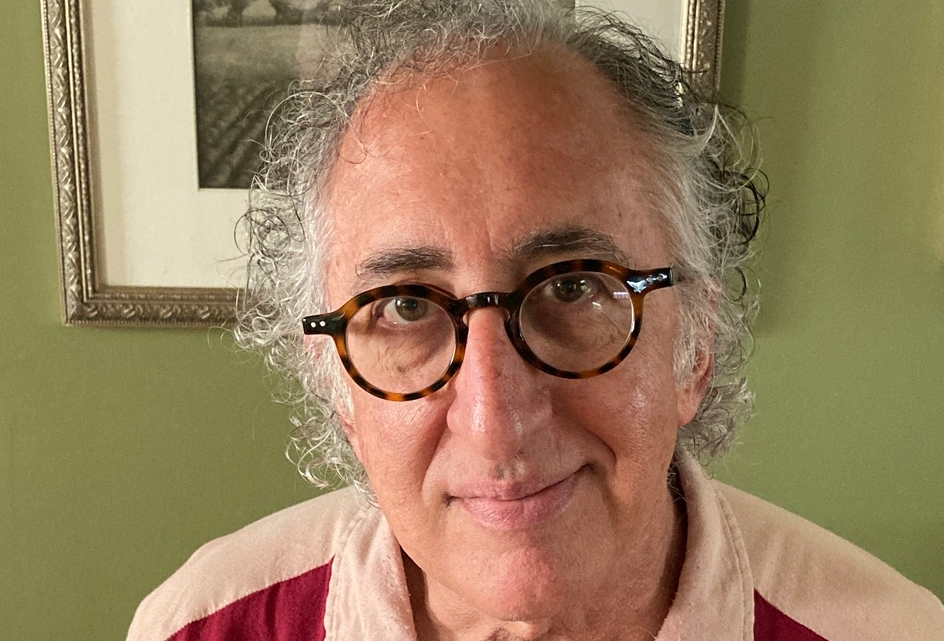
| Q&A with David Greenberger
| Mark Swartz
| David Greenberger is one of my personal heroes, and his work led indirectly to the creation of Aging in America News. A writer, artist, and performer, he is best known for Duplex Planet, a zine he published from 1979 to 2010 that was based on conversations with the residents of the Boston nursing home where he worked. He recently released a set of monologues based on conversations at the Adult & Senior Center of Saratoga and Home of the Good Shepherd, Saratoga Springs, NY. “Universal Preservation” is available on Bandcamp.
How did you start documenting your conversations with older people?
In the mid-1970s, I’d just finished art school, and I flew out to Palm Springs to drive my grandmother’s Oldsmobile back to Chicago for her while she would fly with my great aunt. While I was there, I met her friend Herb, and we hung out for a day. We went to go buy fish, and we went to a flea market, and I realized, for the first time in my life, I was having interactions with somebody who was three times my age but wasn’t a relative.
Explore “Beyond Duplex Planet,” the forthcoming documentary by Beth Harrington

And these are verbatim, everyday conversations, not interviews.
I think that one of the cultural limitations is that old people are viewed as sometimes simply a repository of their past. I’d rather just be present with them than interview them about their past, in search of pearls of wisdom. Which is a cliché that doesn’t hold up, because pearls don’t just get handed to you. You got to dig for ’em. You might end up with a pearl of wisdom if you actually have a developing relationship with somebody and you get to know them.
I like that. And it might even be ageist to say that the old people have wisdom, because it denies them their ordinary existence and it makes them harder to relate to.
I think that that’s true. I think that it’s a distancing mechanism to not have to go any further with getting to know them. You put somebody on a pedestal, you’re no longer eye to eye.
What was the Duplex?
The Duplex was a 45-bed all-male nursing home in the Jamaica Plain neighborhood of Boston. This is before Medicaid led to larger, for-profit nursing homes. I’m not saying that that’s a bad thing, but there was value in those mom-and-pop converted houses. It was owned by a guy named Raymond Murphy. His father had owned it before him. And he brought to bear a kind of an understanding when you need to bend the rules.
It’s gotten very corporate since then, and we’re segregated by age now.
There was a normalizing. You’d see them at the ice cream parlor, and it would be like, oh, that’s the old people.
Were you afraid that if he found out you were making a zine, the owner would tell you that you couldn’t do it anymore?
Oh, no, no. From the very beginning, when it started, I thought, well, this would be an activity. I had to come with activities to do. Ray Murphy knew that, and while he might not have been an area he would’ve explored, he understood that it was something that I was doing and that it was honest and true. He didn’t say that precisely. It was more like, I don’t quite know what this is, but I’m really glad you’re doing it.
Do you consider yourself an advocate for older Americans?
I would say that I’m more an advocate for the dynamic and nature of how we come to know a person through the ordinary things in their life. When people tell you something extraordinary they did, that’s basically what makes them different than you. But it’s in the ordinary things where we find a level of comfort.
Ordinary things, and ordinary conversations, too.
Talking to somebody in the checkout line, talking to somebody on a plane trip, when you have one of those rare sort of great conversations, which we’ve all had different times where it’s like, Wow, I just started talking and all of a sudden the plane was landing, it was two hours later. I’ve had the richest conversations with people who have deep passion for stuff that I know nothing about, but you get a buzz from somebody’s passion for something. Sometimes it’s easier if it’s not the same passion as yours.
Discover “Growing Old in East L.A.“
Over the years, Duplex Planet moved from the page to live and recorded performance with music. How does this change how people experience your work?
I want people to not have their bearings in this. I feel like an art experience can be something where the agreement that I’ve made with them is if you’ll come in here and sit down and we’ll darken the room, things will happen that are outside what you knew before you came in. We’re taught that from an early age in school that you answer the question and you’ll get a gold star. But I think a lot of experiences in life, with art being a sort of metaphor for it, are inexplicable.
Have people along the way accused you of exploiting older people and making fun of the way they talk or the way they repeat themselves?
They have, but I know that I’m not doing anything to exploit these people. I’m trying to expose the idea of the various faces of aging that are sometimes easier to see when they’re not your parents or your grandparents, because you’re not tied to their mortality. You can just sort of bear witness to very real things that happen to people all around us.
You’ve got to be okay with making the audience uncomfortable.
I feel like people who are uncomfortable with it are basically saying, ‘Keep that hidden from me. I do not want to know about this possible eventuality in life.’ But that’s how their life is. There’s validity to their life in this changed way. They’re heading into the unknown, and so a level of fogginess and befuddlement, it feels like it’s softening the pathway to that unknown end.
Given all your experience with the elderly, how does it feel when members of your own family get older?
My mother is 93, and I saw her last Thanksgiving. I don’t think she knows exactly who we are, but she’s her same cheerful self. She was a pianist, an accompanist for theaters. We found a place in Atlanta where the piano could be in her room with her. She doesn’t play it anymore, but I think it’s just an anchor. She doesn’t know who I am, but that’s on me to accept that.


 Aging in America News
Leave a comment