| Building the Future of Alternative Mobility
| Shayna Gleason
Imagine yourself losing access to whatever form of transportation you use most right now. What would you do instead? How would you buy groceries, see friends, access not only your doctor but your favorite park and movie theater and post office? How would you feel, having to ask for help getting around, whether from people you love or from a public agency?
In a society built for cars, transportation remains one of the most important determinants of well-being in later life. Only 46% of older adults who do not drive leave home on a given day, compared with 83% of those who do drive, and large numbers of these non-drivers report that the inability to drive prevents them from doing activities they need or want to do. But this immobility is not an inevitability; it is a public choice, shaped by policy and planning and funding. The good news is that we have the tools to shore up people’s ability to remain connected to their communities throughout the lifespan.

Beyond the traditional models, without losing our purpose
New technologies have ushered in a new era of transportation service for older adults, offering greater flexibility and geographical coverage in some places than ever before. One of the latest innovations in public transportation has been microtransit, or on-demand, origin-to-destination (curb-to-curb) public transportation that serves the general public but is accessible to those using wheelchairs. Riders usually book microtransit trips through a phone app, much like summoning a ride-share vehicle; this practice allows for greater spontaneity than typical Americans with Disabilities Act (ADA) complementary paratransit, which usually requires reservations in advance. Microtransit offers an on-demand option that is both cheaper and more accessible than the typical offerings of a transportation network company—a big leap forward for the transit industry. It also lacks the stringent eligibility criteria that most paratransit services have, making it available to a greater swath of older adults. Nonetheless, microtransit is expensive to provide when compared with fixed-route public transportation and usually does not offer the same level of passenger assistance or civil rights protection that paratransit does. As currently implemented, it also often operates only in certain “zones,” rather than across an entire metropolitan area. Greater proliferation and coverage of microtransit or other on-demand public transit service will require serious and sustained local investment.
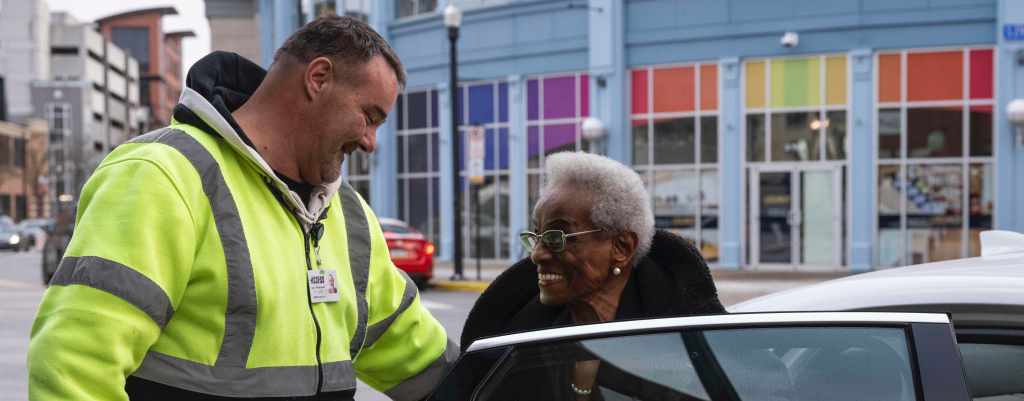
Not all innovations, though, have had such a cost. Many ADA complementary paratransit services are working hard to provide more responsive service, even in highly constrained funding environments. One example is “hand-to-hand” service for people living with dementia or intellectual disabilities. Advocates have long emphasized that people with certain cognitive impairments cannot make full, safe use of public transportation without some level of supervision and assistance on both ends of the trip. Hand-to-hand policies ensure that drivers do not leave these riders at their destination until they are under the care of a responsible adult. ACCESS Transportation Systems in Pittsburgh, PA is one such system that has provided hand-to-hand service for years to riders who need it.
Sometimes all that’s needed to help older adults make access of an existing service is a little guidance and support, and not a formal service modification. A great example comes from the Boston Bus Buddies program, where volunteers (who may be older adults themselves) provide company for older riders on their first few bus or subway trips. Travel training, whether professional or volunteer, can help new riders feel comfortable on a transit system and develop confidence in their own ability to track vehicle schedules, board and alight, pay the fare, and otherwise become savvy transit customers. This type of program is especially important for the many older adults who had never ridden public transportation regularly in their earlier years, but find themselves needing it when driving is no longer an option.
The road ahead
As the United States ages, we are faced with a choice. We can choose a world in which everyone must fend for themselves in older adulthood, in terms of care, transportation, and other needs. Or we can embrace a different vision: we can invest in transportation systems that make sure everyone can get where they need to go, and not just for medical appointments. We can see older community members as assets rather than liabilities. I am writing this shortly after my thirtieth birthday; I bet you can guess which world I hope to find myself in one day.
Shayna Gleason is a Research Fellow with the Center for Social and Demographic Research on Aging (CSDRA) at the University of Massachusetts Boston.

 Aging in America News
Leave a comment