| How Age Blaming Lost 2024’s Longevity Moment
| Paul Kleyman |
Six months into Trump’s second term and a year since the Biden-Trump debate that eventually led to Kamala Harris becoming the Democratic nominee, I’m still thinking about the role that ageism played in the election.
While the GOP backed its elder nominee regardless of his cavernous flaws (and felonies), the Democrats sank into derogating their incumbent as being “too old.” Even after Harris replaced Joe Biden at the top of the Democratic ticket, age remained on the ballot.
I’m happy to leave it to the politicrats and historians to dissect the 2024 electoral lab frogs to discern the partisan strategies that left the Republicans doing victory laps in their creaky tank. That left the Dem operatives grappling at each other online and between hard covers.
Going for the takedown on the mat, CNN’s Jake Tapper and Alex Thompson with their bestseller, Original Sin. In position to flip and pin the centrists, former U.S. Labor Secretary and one-time high school wrestler, Robert Reich, whose forthcoming memoir, Coming Up Short (Penguin/Random House) comes out in August. Also, sweating hard for working Americans, law professor Joan C. Williamson’s Outclassed: How the Left Lost the Working Class and How to Win Them Back (St. Martin’s/McMillan, 2025).
A president too aged, or a party long compromised? The Democrats’ future will inevitably sweat in the grip of voters. To disentangle factional presumptions from actual election trends, New York Times political reporter, Shane Goldmacher spent months poring over voting trends in every one of the 3,100 counties in the United States for the four elections since 2012, before Donald Trump came down his golden escalator four years later.
Goldmacher’s chart-heavy article was headlined, “The Democrats’ problems run deep, nearly everywhere.” Elsewhere the story stated, “Republicans are overwhelmingly making gains in working-class counties.”
He determined that Trump’s support improved since 2016, in nearly half of American counties, (1,433), only three of which had incomes exceeding $100,000 a year. In the meantime, the Democratic vote increased in only 57 counties, 18 of which were “wealthy enclaves.”

It’s likely that almost all of those counties aren’t getting any younger in this rapidly aging nation. Yet, as the Democrats pick at and parse the 2024 results, both party stalwarts and rebels would do well to heed one of Goldmacher’s conclusion.
During a June 3 Times podcast about his investigation, Goldmacher stated, “I think that a lot of people have looked at the 2024 election and said the Democratic Party lost because Joe Biden was too old, that he stayed in the race too long, that Kamala Harris was a weaker candidate, that she didn’t have enough time to prosecute the case, and on and on. But the 2024 election results were not a one-off. They weren’t a one-off at all.”
While many liberal pundits and politicos have been quick to assert that Kamala Harris’s race and gender surely cost her pivotal ballots, few but advocates for older Americans point to the impact of age bias on Joe Biden’s path to his renomination.
And few news viewers learned that growing numbers of us are able to enjoy vitally engaged later years. Certainly, the well-off, such as Biden or Sen. Mitch McConnell, regardless of their ailments, tend to live and manage well beyond ages shown on average mortality charts, the kind cited in many articles to justify worries about the former president’s turning 80.
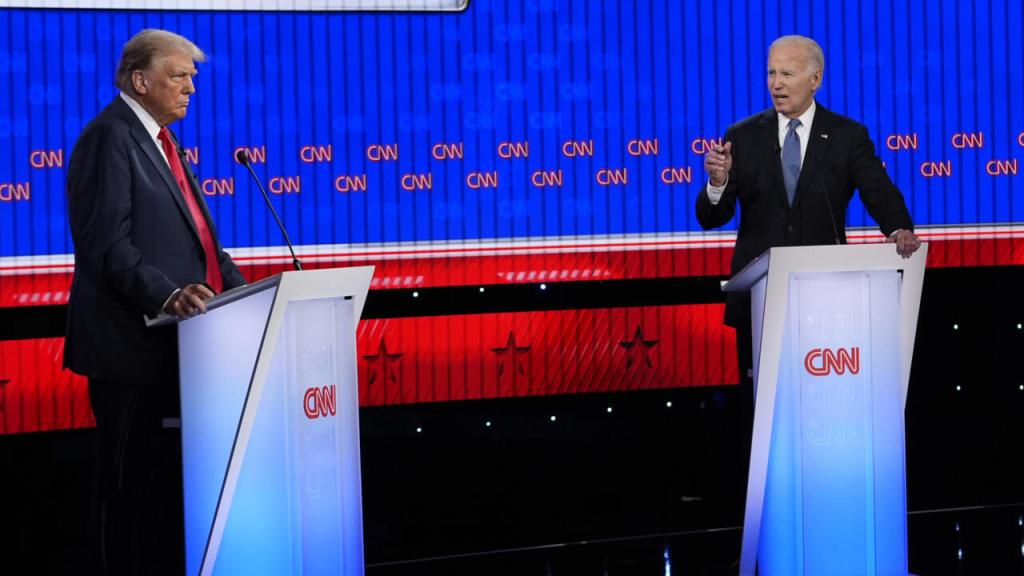
As the 2024 election season became overwintered for this otherwise capable chief executive—an incumbent later deemed to have conducted the “most consequential first term” in a half century—his June 27 debate performance dropped his prospects for renomination like a gallows trap door.
Meanwhile, Biden’s GOP opponent blustered incoherently—although forcefully–at times during the debate, and uttered “well-worn falsehoods . . . , including claims that migrants have carried out a crime wave,” along with “incendiary rhetoric” and threats of retribution against his opponents, as Reuters reported the next day.
The 45th president did so with the fervent backing of his party operatives and billionaire donors, while the Democrats gave their elected leader of the free world little credit for his immediate recovery the next morning. Biden would culminate a marathon schedule of speeches over the next 10 days with a grinding effort at the NATO summit, which successfully shored up European support for Ukraine. Yet his otherwise successful negotiations and cogent speech remained dogged by the national media’s dotting on his vocal slips toward the end.
What should become more evident is that our societal disdain for signs of old age—excepting only the performative bellowing of even a corrupt and convicted older blowhard—sadly continues to propagate this culture’s ignorance of America’s burgeoning advantage as a rapidly growing older population.
Paul Kleyman is National Coordinator of the Journalists Network on Generations (JNG), which he co-founded in 1993. He edits its e-newsletter, Generations Beat Online (GBONews.org).
 Aging in America News
Leave a comment