Q&A with Ageless Innovation’s Ted Fischer
In this episode of the Abundant Aging Podcast, Michael Hughes of United Church Homes interviews Ted Fischer, CEO of Ageless Innovation. Previously, Fischer led the launch of Hasbro’s Joy for All brand. This interview has been edited for length and clarity.
You could be doing a lot of things. What led you into this world of aging?
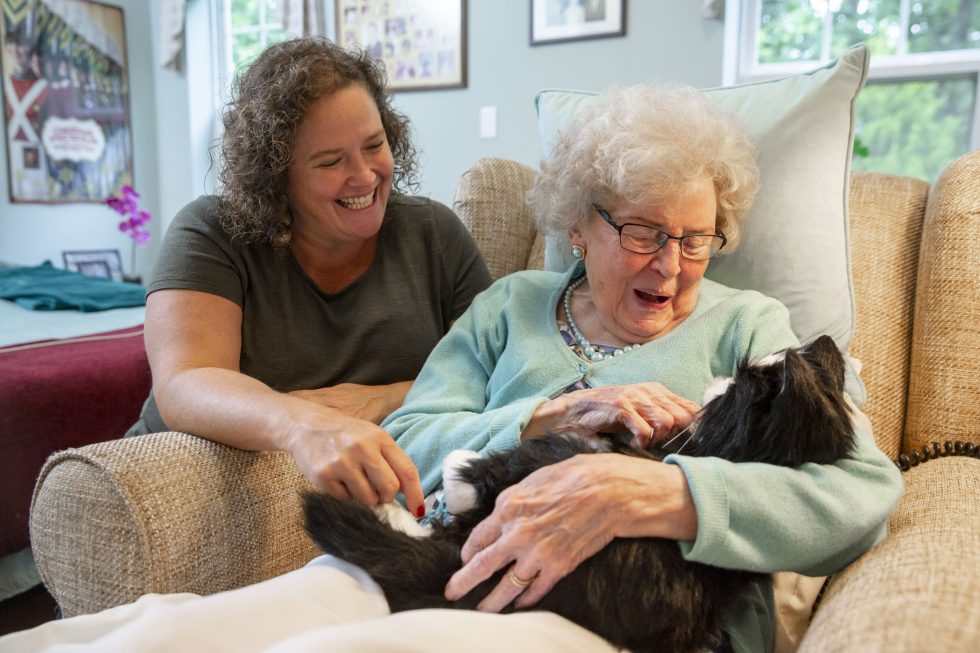
It started when I was at Hasbro, with looking the data for unintended end uses, and we found this data on an animatronic toy that was originally designed for 4- to 8-year-old girls. About 20% of the reviews of this weren’t written by moms who had bought it for little girls but for an aging loved one. They’d write these reviews about how this toy product was having this really meaningful impact. And so that was the key insight: Every single older adult wants to have more fun, joy, and play in their life. There’s also an incredible need for interactive companionship.
Tell me about the Fun Lab.
We have this place at Hasbro called the Fun Lab. On one side, it looks like a living room or a bedroom, where you can set it up for any sort of scenario. And behind the wall are all the designers and engineers, and they watch children, typically, come in to play with new concepts or they put a bunch of things out, see what resonates, what needs explanation, what doesn’t. It is the coolest place ever. You get to see the reaction of people on the first time. We brought a group of older adults for the first time ever into the fun lab and showed them all these things. We watched the incredible joy and happiness that was happening. The older adults weren’t just having fun playing. They were so happy and excited that someone was thinking about them in this way.
You are some of the first people who are designing for older people. You’re asking, ‘Will people engage? Will people come back?’
Our whole design philosophy is listen, do something, show it. Take the feedback, iterate, go back and do it again, until they say, “Boy, this really looks like a real cat,” or “This game is really fun,” or whatever it might be. And so older adults have been more than just part of our design philosophy. They’ve been the designers, really.
What surprises have you encountered along the way?
If you had told me 10 years ago that in a memory care sort of community where we had agitated older adults who were difficult in transition, and, instead of giving a psychotropic medication, you gave them a pet, and it made them happy and joyful and they went without issue, I would’ve been like, ‘Yeah, I’m not so sure.’ I’ve seen it now many times. And so I would love to think I was that smart, but I’m not. But we’re pretty good at following the insights. When you think about it, with all the side effects of medications, it’s not going to work for everybody, but if it works for some significant percentage of the population, that’s fantastic.
I can’t think of anything more predictable in terms of future market demand than climate change and aging. We’re talking about the first baby boomer turning 80 in 2026. We’re talking about more people over the age of 65 by 2034 than under the age of 18. But you took this outside of Hasbro, you started Ageless Innovation. How the heck did you pull that off?
It’s a long story, but in the end, I met with the president of the company and said, “Listen, there’s a real opportunity here, but I think it’s going to be harder to do here than I anticipated.” And so we came up with a deal that works for everybody. We left six years ago to start Ageless Innovation, and now we’re able to focus a hundred percent older adults and their families.
What is the mission and vision of Ageless Innovation?
I don’t talk about mission and vision as much as I do purpose. Our purpose is to reimagine how we positively live and age together by unleashing the power of play. And what we’ve seen is that on its most basic level, when people are playing, they’re happy, and when they’re happy, they feel better. It’s just that simple. We don’t overcomplicate. None of us are doctors. But the energy and enthusiasm, it’s palpable.
 Aging in America News
Leave a comment