
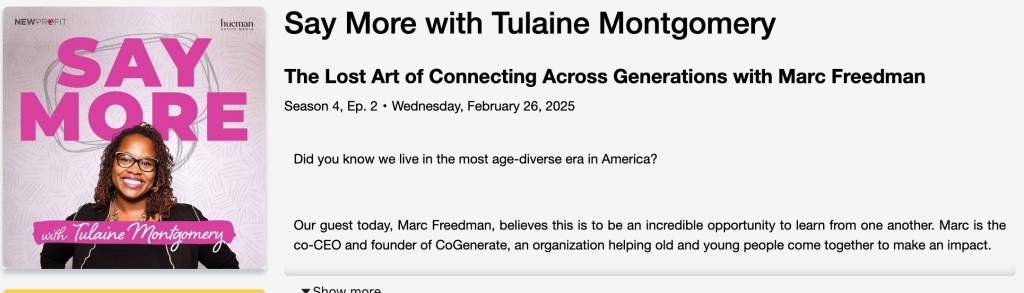
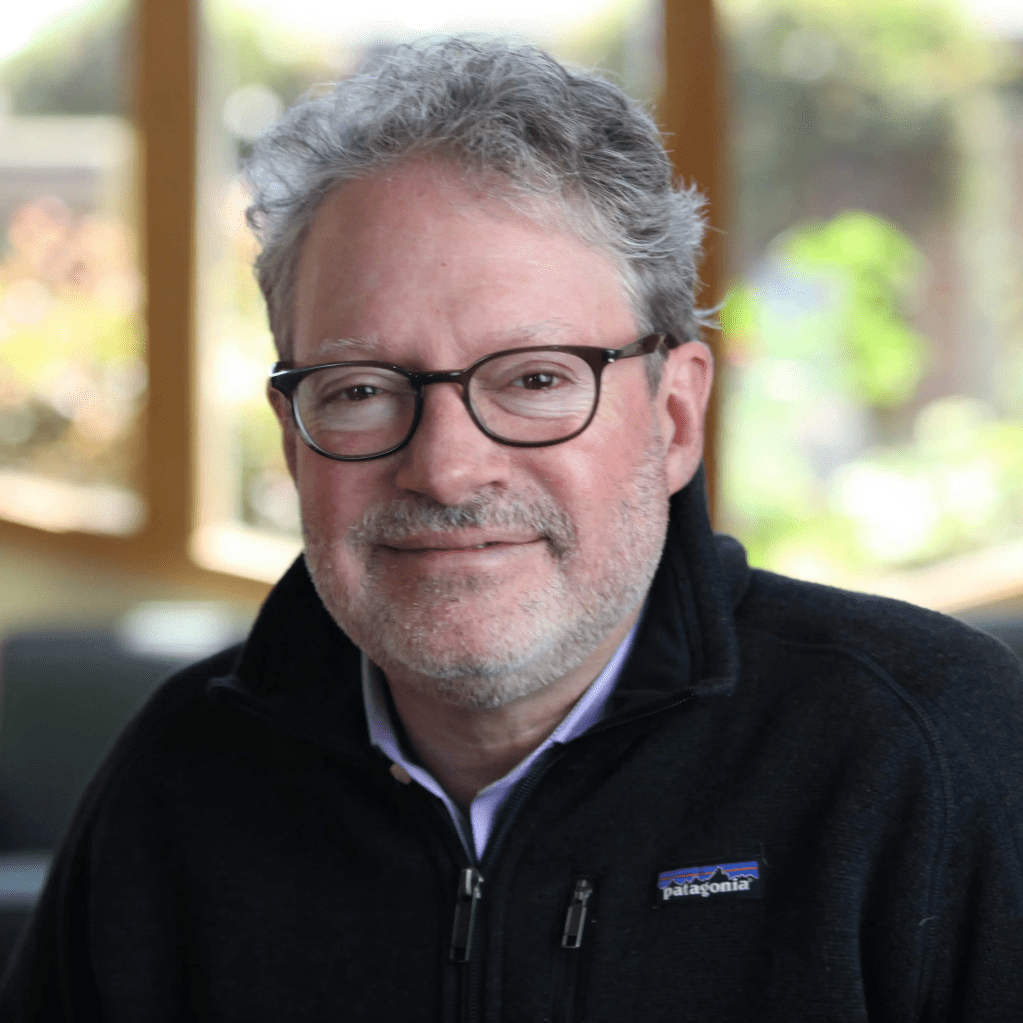
In this episode from the Say More podcast, host Tulaine Montgomery and CoGenerate founder and co-CEO Marc Freedman explore the alchemy of bringing generations together. The transcript of their February 2025 conversation has been edited for the sake of brevity.
What do you love about the stage of life you’re in right now?
Even as a young person, I loved to work with, to learn from older people. And I spent my whole life talking about the virtues of elders and what they brought to society and how we needed to appreciate that. And now I’m actually in that stage, and so I can talk from personal experience, from lived experience. I’m 66 now; I qualified for Medicare last year. I find myself still looking for older people.
If we can put more dedication and resources into the intergenerational relationship, that will do a lot to amplify our ability to connect across multiracial identities because it feels like, by and large, younger people have fewer barriers to connection across identity.
john a. powell at the Othering & Belonging Institute at University of California Berkeley has talked about this cross-generational connection as being a “short bridge.” It’s the place where we can make the most progress, and the timing of doing that couldn’t be better. We hear a lot about the aging of society, about growing longevity, but I think the big transformation demographically that’s underway and fully underappreciated is age diversity.
Is that what you mean by co-generation?
Our organization has always focused on what older people can do to support younger generations, what they owe younger generations, but cogeneration is really about the with—what older and younger people can do together to forge bonds, bridge divides, solve problems. When generations come together, they can create power.
The University of Chicago’s AmeriSpeak survey puts it very starkly: “We’re living in the most age-diverse society in human history. Will we make the most of it?” That really struck me. What would have to be true for us to make the most of this moment?
We radically reorganized American society over the last century by age, to the point where it just seems natural, but in fact it’s an aberration in all of human history. For millennia people of different ages lived together, worked together, learned from each other. And yet, we decided that people were better apart over the last century. It leaves us ill prepared for a society of so much age diversity. And it’s leading to isolation and loneliness. It’s leading to misunderstandings, to ageism both towards older people but also younger people. So I think it’s time to recognize that that’s not going to serve us well in a multigenerational future that contains enormous possibilities.
What do you see as the wisest best approach to getting ourselves ready to leverage the power of the moment we’re actually moving into as a society?
I had a conversation with PolicyLink’s Angela Glover Blackwell, and she hit upon a beautiful phrase, which I think about all the time because it challenges my stereotype. She said we needed to leverage the wisdom of the young and the curiosity of the old. It’s easy to think in stereotypical terms, but I think there are some surprising opportunities in front of us.
What I’m hearing you say is that really pouring into the power of relationship proximity across generations is the tried-and-true way to have a shot at having the kind of lives that we want to deserve in this age-diverse moment.
There’s a wonderful quote from Urie Bronfenbrenner, who was a pioneer in child development. At the end of his career, he was asked by a journalist, ‘You’ve written 20 books, a thousand articles. What have you learned that the average person could appreciate?’ And he said, ‘What every child needs is at least one adult who’s irrationally crazy about them.’ And one of the things that I’ve learned, partly in becoming an older person myself, is that older people need to be irrationally crazy about younger people as well. You see it in any grandparent. But it turns out that as we get older and we realize that there are fewer days ahead than behind, it has a powerful effect on priorities, and relationships come to the forefront.
What’s the playbook for exploring the upside of age diversity?
The real opportunity of the moment in that realm of collaboration for the greater good is in older and younger coming together to work on big problems. I saw that in our founding project, Experience Corps, where we’re mobilizing older people to help young people read. By the third grade, we unintentionally had a crop of young AmeriCorps VISTAs who came into the program. And to our amazement, surprise, delight, the bonds that formed between the older Experience Corps members and these younger AmeriCorps members was as powerful as anything that was happening with the children.
What’s the connection between intergenerational relationships and social change?
There’s a social change just in intergenerational relationships, a system change that these bonds embody because we’ve created a system that separates people by age and suggests they’re better apart than better together. But I think that there is, to go back again to that University of Chicago study, there is an enormous number of young people who want to work across generational lines to create a better future.
 Aging in America News
Leave a comment